
Jeddah–Islamabad flight narrowly avoids major disaster
- By Salah Uddin -
- Nov 26, 2025


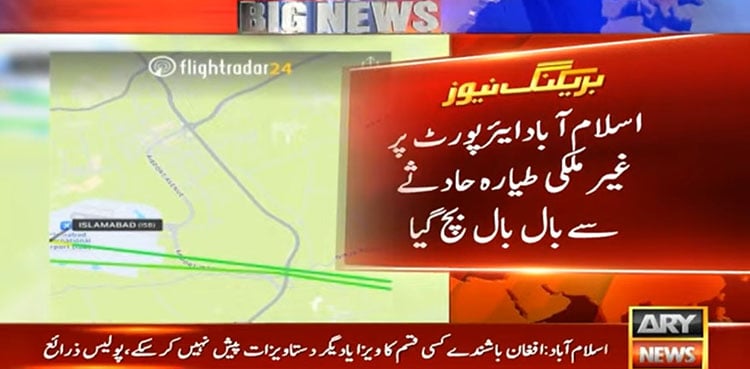
ISLAMABAD: A major accident was averted at Islamabad International Airport when a foreign airline’s Boeing 777 narrowly escaped landing on a closed runway, ARY News reported.
According to airport authorities, the Boeing 777 aircraft, arriving from Jeddah, mistakenly attempted to land on Runway 28 Left, which has been closed for maintenance. A NOTAM (Notice to Airmen) had already been issued, informing all pilots that Runway 28 Left was shut while Runway 28 Right remained operational.
Despite this, the pilot aligned the aircraft for landing on the closed runway. The Air Traffic Controller (ATC), monitoring the approach on radar, immediately alerted the pilot that he was heading toward the wrong runway.
However, the Boeing 777 pilot insisted several times that he was on the correct approach, the Airport Authority spokesperson said. With only moments left before touchdown and with people and vehicles present on the closed runway, the ATC urgently instructed the captain to abort the landing and go around.
The timely intervention prevented a potential catastrophe at Islamabad Airport, as the Boeing 777 was carrying hundreds of passengers.
During the second attempt, the aircraft successfully landed on the correct Runway 28 Right.
Airport authorities stated that, had the ATC not intervened at the last moment, a serious accident could have occurred. The Pakistan Airports Authority has taken official notice of the incident, and a detailed inquiry is underway.
The Pakistan Airports Authority (PAA): Role, Revenues, and Concessions
The Pakistan Airports Authority (PAA) facilitates around 400 to 450 overflights through Pakistan’s airspace every day. Overflight charges are calculated based on the aircraft’s maximum takeoff weight (MTOW), ranging between $0.44 and $1.30 per kilometer. PAA does not levy any taxes on passengers; excise duties are imposed and collected directly by the Federal Board of Revenue (FBR).
Revenue Structure and Reinvestment
In addition to overflight and landing-related charges, PAA collects airport charges from departing passengers—both domestic and international—at the rate of PKR 600 for domestic and PKR 4,600 for international departures. These charges form a vital part of PAA’s revenue stream and are reinvested into enhancing airport infrastructure, passenger services, and operational efficiency. The funds are utilized for terminal improvements, expansion of facilities, modernization of equipment, and ensuring a safe, comfortable, and seamless passenger experience at all airports under PAA’s management.
Landing charges are determined according to the aircraft’s MTOW, while parking charges are applied on a per-ton, per-hour basis, with the first two hours being free for both domestic and international aircraft. There are no separate takeoff or double-charge provisions.
Concessions and Regulatory Oversight
As part of its facilitative policy for the aviation sector, PAA extends several concessions to airlines:
-
No air navigation charges are applied to domestic flights.
-
Scheduled services face no landing or housing charges at secondary airports.
-
Domestic tariff rates have not been revised or increased for over a decade.
These measures reflect PAA’s commitment to supporting the sustainable growth of Pakistan’s aviation industry and promoting air connectivity across all regions of the country.