
Antarctica's mysterious 'gravity hole' linked to its icy climate history
- By Web Desk -
- Feb 23, 2026


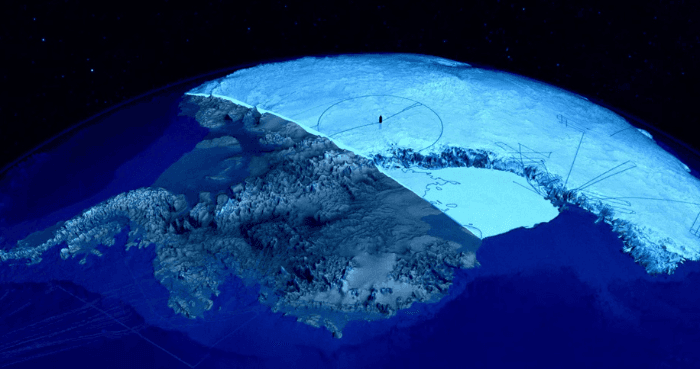
For decades, scientists have explored enormous depressions in the Earth’s crust called “gravity holes,” where gravity is significantly weaker than usual. Now, new research indicates that a large gravity hole beneath Antarctica could be closely tied to the continent’s climate evolution.
In a study published in Scientific Reports, researchers from the University of Florida and the Paris Institute of Earth Physics mapped the slow movement of rocks deep under the Antarctic ice. Using seismic waves, similar to how a medical CT scan visualizes the human body, they reconstructed the region’s underground history over the past 70 million years.
The researchers found that Antarctica’s gravity hole has gradually become more intense since the time of the dinosaurs. Importantly, this underground strengthening aligns with major changes in the continent’s surface climate, such as the widespread development of its massive glaciers.
Although the study does not definitively prove that changes in gravity directly caused the ice sheets to grow, it reveals a strong correlation between deep-Earth tectonic activity and surface climate conditions. The team now plans to investigate whether the increasing gravity hole influences long-term sea-level fluctuations and ocean acidity.
“How does our climate connect to what’s going on inside our planet?” asked co-author Alessandro Forte, a geophysics professor at the University of Florida.
“If we can better understand how Earth’s interior affects gravity and sea levels, we gain insights into factors that could impact the growth and stability of large ice sheets.”