
Aurangzeb calls for unlocking Pakistan’s $100 billion 'Blue Economy' potential
- By Web Desk -
- Nov 04, 2025


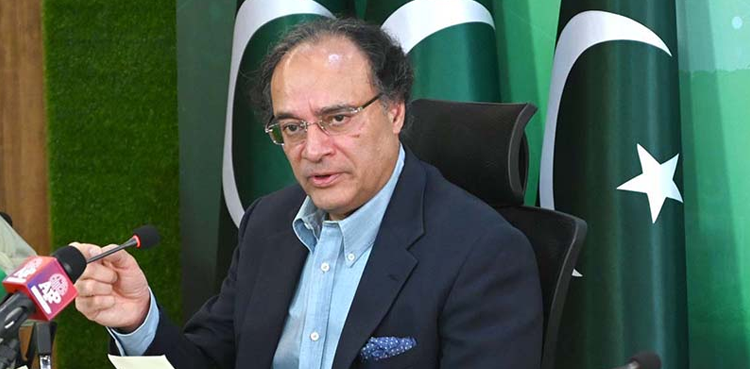
ISLAMABAD: Federal Minister for Finance and Revenue Senator Muhammad Aurangzeb has described the blue economy as a potential game changer for Pakistan’s future growth, emphasizing its capacity to generate up to $100 billion by 2047.
The minister made these remarks in a virtual address as the chief guest at the inaugural session of the Pakistan International Maritime Expo and Conference (PIMEC), held at the Expo Center Karachi, jointly organized by the Pakistan Navy and the Ministry of Maritime Affairs, according to a press release issued on Tuesday.
Senator Aurangzeb highlighted the progress Pakistan has achieved in recent years toward restoring macroeconomic stability, noting that the policy rate has declined in line with falling inflation.
He added that all three major global rating agencies have upgraded Pakistan’s outlook to “stable” after nearly three years, signaling renewed international confidence in the country’s economic direction.
Referring to Pakistan’s engagement with the International Monetary Fund (IMF), the finance minister said that the recently concluded staff-level agreement in Washington has further reinforced global confidence in the government’s reform agenda and sound macroeconomic management.
Turning to the maritime sector, Senator Aurangzeb observed that the maritime sector currently contributes only around 0.4 to 0.5 % to the national GDP – approximately USD 1 billion – but holds vast potential for expansion.
He endorsed the Ministry of Maritime Affairs’ vision of developing this into a $100 billion blue economy by 2047, aligning with Pakistan’s 100th anniversary and the broader national ambition of becoming a $3 trillion economy. He described this goal as both ambitious and achievable, supported by a clear and robust roadmap.
He expressed confidence that Pakistan’s seafood exports, currently around $500 million, could feasibly increase to $2 billion within the next three to four years under the National Fisheries and Aquaculture Policy, which has been developed in strategic partnership with the Food and Agriculture Organization (FAO).