
'Blood Moon' to rise tonight during total lunar eclipse
- By Web Desk -
- Sep 07, 2025


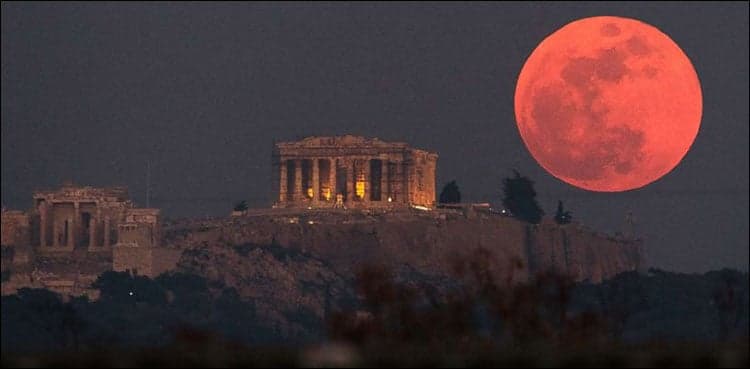
KARACHI: The celestial spectacle of ‘Blood Moon’ can be witnessed across to night as total Lunar Eclipse will be visible in Pakistan, Pakistan Meteorological Department said.
Stargazers will have a chance to see a “Blood Moon” on Sunday night during a total lunar eclipse visible across Asia and swathes of Europe and Africa.
When the Sun, Earth and Moon line up, the shadow cast by the planet on its satellite makes it appear an eerie, deep red colour that has astounded humans for millennia.
People in Asia, including India and China, will be best placed to see Sunday’s total eclipse, which will also be visible on the eastern edge of Africa as well as in western Australia.
Stargazers in Europe and Africa will get a brief chance to see a partial eclipse just as the Moon rises during the early evening, while the Americas will miss out.
The Moon appears red during lunar eclipses because the only sunlight reaching it is “reflected and scattered through the Earth’s atmosphere”, said Ryan Milligan, an astrophysicist at Northern Ireland’s Queen’s University Belfast.
Blue wavelengths of light are shorter than red ones, so are more easily dispersed as they travel through Earth’s atmosphere, he told AFP.
“That’s what gives the moon its red, bloody colour.”
In Pakistan Penumbral Eclipse will begin at 20:28 Pakistan Standard Time (PST) on 07th September. The partial eclipse will begin at 21:27 PST and total eclipse will begin at 22:31 PST.
The maximum lunar eclipse will begin at 23:12 PST while the eclipse will end on 23:53 PST on 07th Sep, according to the PMD.
The partial phase of the lunar eclipse will end at 00:57 PST on 08th September while the penumbral eclipse will come to end at 01:55 PST on 08th Sep.
A lunar eclipse happens when Earth is situated between the Moon and the Sun, causing the Earth’s shadow to fall on the surface of the moon and turn it a rusty red color. Each lunar eclipse is visible from half of Earth, according to the NASA.
The totality phase, when the Earth’s shadow fully covers the moon, is expected to last about one hour and 22 minutes. Overall, it will take three hours and 29 minutes for Earth to pass in front of the moon.
The stages of the eclipse include penumbral and umbral phases, which refer to the two main parts of the shadow that the moon casts. The umbra is a darker inner shadow and the penumbra is a fainter outer shadow.
A total lunar eclipse is a perfect alignment between Earth, the moon and sun. It is different from a partial lunar eclipse, which is an imperfect alignment between the three celestial bodies.
During a total lunar eclipse, the moon moves into the Earth’s inner shadow, which is known as the umbra. Some of the sunlight passing through Earth dimly lights the moon as a result.
Lunar eclipses occur at the full moon phase, according to the NASA.