
Champagne Cluster: Astronomers reveal secrets of massive galaxy collision
- By Web Desk -
- Jan 01, 2026


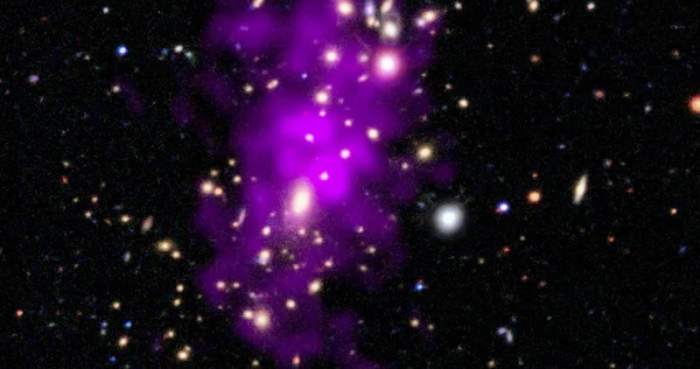
A galaxy cluster discovered on New Year’s Eve 2020 has been officially named the “Champagne Cluster” due to its bubble-like structure and the festive date of its discovery.
A new study published in The Astrophysical Journal by a team of UC Davis astronomers details how this massive merger was revealed through a combination of X-ray and optical light data. A composite image, created using NASA’s Chandra X-ray Observatory and visible-light surveys, provides clear evidence that two galaxy clusters are currently in the midst of a collision.
Astronomers utilized Chandra’s X-ray capabilities to investigate superheated gas within the structure. Typically, gas in such clusters appears as a roughly circular halo. However, in this case, the gas is elongated vertically, indicating that two sub-clusters are colliding.
The image reveals two groups of galaxies flanking a “purple” cloud of multimillion-degree gas. Notably, this gas holds a greater mass than all the visible galaxies combined, yet the cluster contains a significantly larger amount of unseen dark matter.
Unlocking Dark Matter Secrets
According to computer models, these clusters either collided over 2 billion years ago and subsequently reunited, or they experienced a single, violent collision approximately 400 million years ago.
Regardless of the timeline, studying the Champagne Cluster offers scientists a deeper understanding of how dark matter behaves during high-speed collisions.
By observing whether dark matter separates from or remains with regular matter in these extreme scenarios, researchers hope to uncover essential insights about the mysterious substance that makes up the majority of the universe.