
Dollar and Other Currency Rates in Pakistan Today - 09 Feb. 2026
- By Web Desk -
- Feb 09, 2026


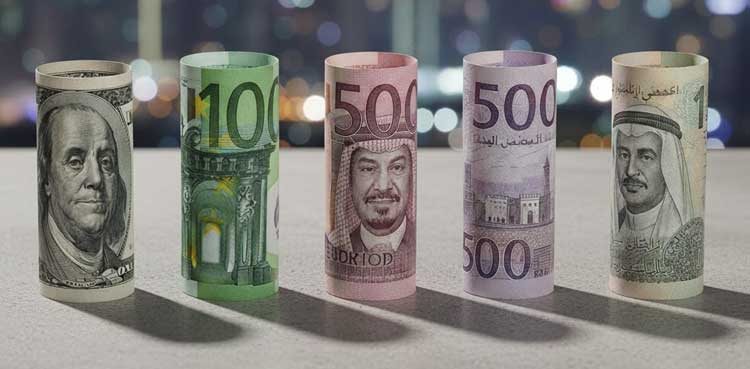
Karachi, 09 February 2026 – The Pakistani rupee firmed in Monday’s session, with the State Bank of Pakistan (SBP) fixing the USD/PKR mark-to-market currency rate at Rs 279.7022, 1 paisa below last close and the leanest print of 2026 so far.
Priority Currencies – Quick Take
1. US Dollar (USD) – 279.70 (spot)
The marginal retreat keeps the greenback anchored to the 279.70 handle, comfortably within the 279–282 range that has governed trade since October. One-week forwards are quoted at 280.07, implying a negligible 0.13 % carrying cost. Exporters continue to offload positions above 280.20, while petroleum importers accumulate on dips below 279.80.
“Market liquidity remains robust; the currency rate is meandering on technical adjustments rather than any fundamental shift,” noted a senior treasury official.
2. British Pound (GBP) – 380.69 (spot)
Sterling advances to 380.69 from Friday’s 379.56; one-year forward is 395.92, translating into 4.0 % annualised rupee depreciation. Garment exporters to Birmingham are hedging six-month receivables near 382, maintaining healthy forward premiums.
3. Saudi Riyal (SAR) – 74.58
SAR edges marginally lower to 74.5793; 12-month forward is 76.71, an annualised 2.9 %—still the narrowest spread among principal remittance channels. Exchange houses report consistent foot traffic from pilgrims securing rates ahead of the February Umrah season.
4. UAE Dirham (AED) – 76.15
AED firms slightly to 76.1498; six-month forward is 77.42, implying 3.3 % annualised rupee softness. Gulf salary remittances continue flowing through official banking corridors, keeping the cross-rate stable.
5. Qatari Riyal (QAR) – 76.75
QAR mirrors regional peers at 76.7464; 12-month forward is 79.60, a 4.2 % annualised differential—virtually matching SAR and AED, underscoring uniform Gulf-peg stability.
6. Kuwaiti Dinar (KWD) – 915.56
KWD gains to 915.5554 on the firmer USD cross. Twelve-month forwards at 958.38 equate to 4.7 % annualised PKR weakness—marginally wider than GCC counterparts due to thinner dinar market depth.
7. Australian Dollar (AUD) – 196.81
The “Aussie” rebounds to 196.81 as iron-ore steadies above $104/t. One-year forward is 202.74, implying 3.0 % annualised rupee depreciation—tracking closely with the SAR curve, affirming commodity-linked volatility.
8. Canadian Dollar (CAD) – 205.04
The “Loonie” firms to 205.04 as WTI crude hovers near $76/bbl. Twelve-month forwards at 215.48 still pencil out to 5.1 % annualised rupee softness, though prairie pulse importers are said to have pre-booked March cargoes, limiting further CAD upside.
Other Major Currencies
Euro opens at 331.75, up 0.6 % on the week following softer Eurozone inflation data; one-year forward is 349.56, translating into 5.4 % annualised rupee weakness. Japanese yen remains the most affordable major at 1.79 per unit, but forwards price 6.2 % annualised PKR decline—the steepest among G-10 pairs. Swiss franc is 361.93; Singapore dollar 220.46; Swedish krona 31.16; Norwegian krone 29.00; Danish krone 44.42; New Zealand dollar 168.44; Chinese yuan 40.37; Turkish lira 6.42; Russian ruble 3.62; Indian rupee 3.09; Bangladeshi taka 2.29—all within familiar ranges and suggesting no event-risk premium ahead of the IMF’s first-quarter 2026 assessment.
Market Context & Outlook
The uniformly compressed forward premiums—scarcely 4–5 % annualised even for the least-liquid crosses—signal to currency desks that both importers and exporters are confident the State Bank retains sufficient firepower to safeguard the rupee through the winter remittance window. Reserves have climbed to $21.26 billion, while the real effective exchange rate (REER) eased to 98.2 in November, a threshold the IMF deems “competitive yet not undervalued.” Barring an oil spike above $90 or political turbulence derailing the Fund programme, dealers anticipate the USD currency rate will stay tethered to the 278–282 zone for Q1 2026, pulling the broader currency matrix along in its wake.