
Dollar and Other Currency Rates in Pakistan Today, 27 Jan. 2026
- By Web Desk -
- Jan 27, 2026


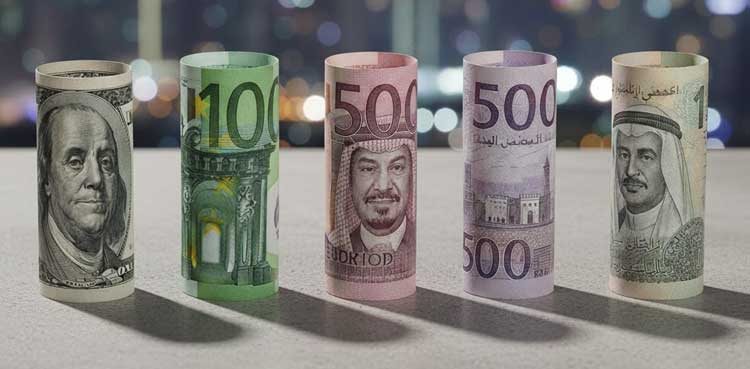
Karachi, 27 January 2026 – The Pakistani rupee firmed in Tuesday’s session, with the State Bank of Pakistan (SBP)’s currency rates report fixing the USD/PKR mark-to-market currency rate at Rs 279.8232, 3 paisa below last close and the leanest print of 2026 so far.
Priority Currencies – Quick Take
1. US Dollar (USD) – 279.82 (spot)
The 3-paisa retreat keeps the greenback glued to the 279.80 handle, well inside the 279–282 band that has framed trade since October. One-week forwards sit at 279.97, implying a wafer-thin 0.05 % carry. Exporters continue to sell above 280.20, while oil importers nibble below 279.80.
“Liquidity is ample; the currency rate is drifting on positional tidy-ups rather than fresh macro cues,” said a senior treasury dealer.
2. British Pound (GBP) – 382.56 (spot)
Sterling vaults into the spotlight at 382.56, gaining sharply from yesterday’s 375.75; one-year forward is 395.94, implying 3.5 % annualised rupee softness. Textile exporters to Manchester are locking in six-month receivables above 384, keeping forward points well bid.
3. Saudi Riyal (SAR) – 74.62
SAR edges marginally to 74.6215; 12-month forward is 76.77, an annualised 2.9 %—still the tightest band among major remittance corridors. Exchange booths see steady demand from Umrah travellers locking in ahead of the January rush.
4. UAE Dirham (AED) – 76.18
AED firms to 76.1838; six-month forward is 77.44, implying 3.2 % annualised rupee softness. UAE salary inflows remain anchored to formal banking, keeping the pair quietly stable.
5. Qatari Riyal (QAR) – 76.78
QAR holds at 76.7796; 12-month forward is 79.57, a 4.2 % annualised gap—virtually identical to SAR and AED, underscoring uniform Gulf-peg calm.
6. Kuwaiti Dinar (KWD) – 917.30
KWD gains to 917.3027 on the firmer USD cross. Twelve-month forwards at 957.81 equate to 4.4 % annualised PKR weakness—marginally wider than GCC peers owing to thinner dinar liquidity.
7. Australian Dollar (AUD) – 193.44
The “Aussie” rebounds sharply to 193.44 as iron-ore steadies above $105/t. One-year forward is 199.38, implying 3.1 % annualised rupee deprecation—almost flat against the SAR curve, confirming commodity-driven moves.
8. Canadian Dollar (CAD) – 203.77
The “Loonie” firms to 203.77 as WTI crude hovers near $76/bbl. Twelve-month forwards at 214.81 still pencil out to 5.4 % annualised rupee softness, but importers of prairie pulses are said to have covered February shipments early, capping further CAD gains.
Other Major Currencies
Euro opens at 331.93, up 0.7 % on the week after softer German CPI data; one-year forward is 349.55, translating into 5.3 % annualised rupee weakness. Japanese yen remains the cheapest major at 1.81 per unit, but forwards price 5.0 % annualised PKR decline—the steepest among G-10 pairs. Swiss franc is 359.58; Singapore dollar 220.35; Swedish krona 31.30; Norwegian krone 28.60; Danish krone 44.44; New Zealand dollar 166.74; Chinese yuan 40.22; Turkish lira 6.45; Russian ruble 3.70; Indian rupee 3.05; Bangladeshi taka 2.29—all inside well-worn ranges and implying no event-risk premium ahead of the IMF’s first-quarter 2026 review.
Market Context & Outlook
The uniformly slender forward premiums—barely 4–5 % annualised even for the least-liquid pairs—tell currency desks that both importers and exporters believe the State Bank has enough cover to defend the rupee through the winter remittance season. Reserves have risen to $21.26 billion, while the real effective exchange rate (REER) slipped to 98.2 in November, a level the IMF considers “competitive but not undervalued.” Unless oil spikes above $90 or political noise disrupts the Fund programme, traders expect the USD currency rate to remain hand-cuffed to the 278–282 corridor for the opening quarter of 2026, dragging the rest of the currency mosaic along in its slipstream.