
Dollar and other Currency Rates Today in Pakistan- Nov. 20, 2025
- By Web Desk -
- Nov 20, 2025


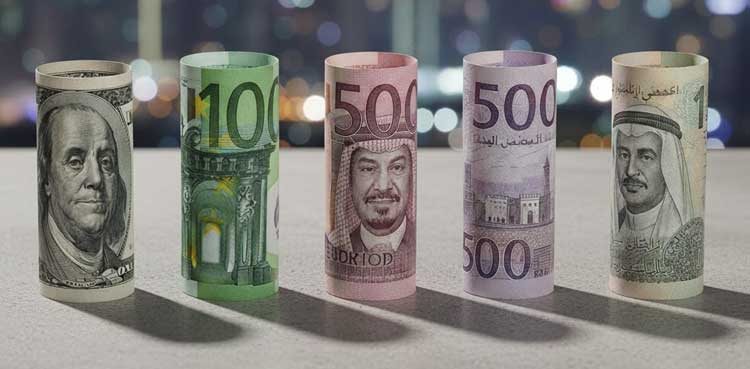
Karachi, 20 November 2025 – The Pakistani rupee eked out a marginal gain against the US dollar in Thursday’s interbank session, as the State Bank of Pakistan (SBP) released latest Market to Market currency rates for today.
1. US Dollar (USD) – 280.65 (spot)
The 6-paisa dip cuts the greenback’s November gain to just 9 paisa, reinforcing a 279–282 range that has held since late October. One-week forwards are quoted at 280.85, implying a carrying cost of only 0.08 %—a sign that liquidity is balanced and the central bank is not seen leaning against the market.
Exporters are selling above 281.00 while oil importers buy below 280.50; the equilibrium feels durable at least until the next IMF review,” said a senior dealer at a major domestic bank.
2. Saudi Riyal (SAR) – 74.83
The Kingdom’s currency eased 2 paisa to 74.83, trimming its monthly rise to 5 paisa. Forward premiums out to one year remain below 3.5 % annualized, keeping Hajj remittance hedging cheap. Exchange companies in Karachi report brisk walk-in demand from pilgrims who prefer to lock rates now rather than wait for the usual December rush.
3. UAE Dirham (AED) – 76.42
Dirham spot slipped 1 paisa to 76.42; six-month forward is 77.74, an annualized 3.4 %—the flattest curve among major remittance currencies. Treasury desks say UAE-based employers are switching more salary disbursements to official channels, a trend that should support the rupee into the winter months.
4. Qatari Riyal (QAR) – 77.00
Qatar’s unit shed 1 paisa to 77.00 but still trades at a 1.6 % premium to SAR, reflecting the minor cross-rate difference on LSEG rather than any Pakistan-specific factor. One-year forward is 80.31, implying 4.3 % annualized rupee softness—almost identical to SAR and AED, underscoring uniform Gulf-peg stability.
5. Kuwaiti Dinar (KWD) – 913.10
The world’s highest-valued currency eased Rs 2.2 to 913.10 as the USD leg softened. Twelve-month forwards at 960.29 pencil out to 5.2 % annualised PKR weakness—marginally wider than SAR owing to lower dinar liquidity rather than macro concern.
6. Bahraini Dinar (BHD) – 744.41
BHD eased 13 paisa to 744.41; six-month forward is 755.33, an annualized 2.9 %—still the flattest curve among GCC pairs. Manama remains a small but stable source of IT and hospitality remittances; dealers do not foresee any breakout from the 740–750 range this fiscal year.
7. Australian Dollar (AUD) – 181.69
The “Aussie” hit a two-month low of 181.69 as iron-ore futures dropped below $100/t and the RBA hinted at a December pause. One-year forward is 189.59, implying 4.3 % annualized rupee depreciation—almost flat against the SAR curve, meaning AUD/PKR moves are driven purely by commodity swings rather than PKR sentiment.
8. Canadian Dollar (CAD) – 199.63
The “Loonie” finally slipped below 200 to 199.63 as WTI crude retreated to $76/bbl. Twelve-month forwards at 211.44 still pencil out to 5.9 % annualized rupee softness, the steepest among the eight priority units, but spot traders say any further CAD weakness will be capped by seasonal pulse imports from Saskatchewan.
Other Majors – Single-Paragraph Round-Up
Euro opened at 323.30, down 1.9 % since Monday on softer-than-expected German PMI data; one-year forward is 343.21, translating into 6.2 % annualised rupee weakness. Sterling eased to 366.84, little moved after BoE rhetoric cooled rate-cut bets. Japanese yen remains the cheapest major at 1.78 per unit, but forwards price 7.8 % annualised PKR decline—the steepest among G-10 pairs owing to ultra-low yen carry. Swiss franc is 348.10; Singapore dollar 214.66; Swedish krona 29.38; Norwegian krone 27.55; Danish krone 43.29; New Zealand dollar 157.35; Chinese yuan 39.44; Turkish lira 6.62; Russian ruble 3.48; Indian rupee 3.17; Bangladeshi taka 2.29—all inside well-worn ranges and implying no event-risk premium ahead of the IMF’s first-quarter 2026 review.
Market Context & Outlook
The uniformly narrow forward premiums—barely 5–6 % annualized even for the least-liquid pairs—tell currency desks that both importers and exporters believe the State Bank has enough cover to defend the rupee through the winter remittance season. Reserves have risen $1.5 billion in six weeks to $14.8 billion, while the real effective exchange rate (REER) slipped to 98.2 in October, a level the IMF considers “competitive but not undervalued.” Unless oil spikes above $90 or political noise disrupts the Fund prograم, traders expect USD/PKR to remain hand-cuffed to the 279–282 corridor for the rest of 2025, dragging the rest of the currency mosaic along in its slipstream.