
Fusion reactors may be key to creating dark matter, new theory finds
- By Web Desk -
- Dec 29, 2025


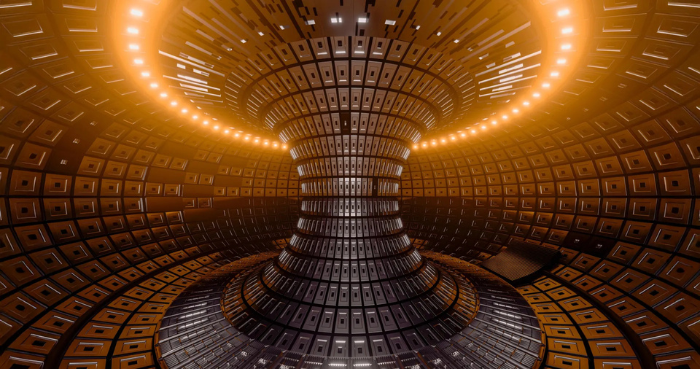
A University of Cincinnati physicist and an international team have theoretically solved a problem that stumped characters on The Big Bang Theory show: how to produce axions inside fusion reactors.
On the hit sitcom, physicists Sheldon Cooper and Leonard Hofstadter wrestled with this concept across three episodes but failed to make it work. Now, UC professor Jure Zupan and colleagues from Fermi Lab and MIT have published a solution in the Journal of High Energy Physics.
Axions are theoretical subatomic particles believed to make up dark matter, the invisible substance that composes most of the universe’s mass. While never detected directly, dark matter’s gravitational pull shapes galaxies.
The team scrutinized a fusion reactor design using deuterium and tritium fuel inside a lithium-lined vessel, similar to the ITER project in France. They found that neutrons generated in the reactor could interact with the walls or slow down via “braking radiation,” theoretically creating axions.
Zupan explained that the TV show’s “failure” was actually hidden in a background whiteboard equation. The characters tried to produce axions using solar processes, which resulted in a drawn “sad face” because the sun is simply too powerful to compete with.
“The chance of having new particles produced from the sun… is larger than having them produced in fusion reactors using the same processes,” Zupan said. “However, one can still produce them in reactors using a different set of processes.”
By identifying these alternative mechanisms, the real-world team succeeded where the fictional geniuses failed.