
Gold nanoparticles form via ‘nano-factory’ on pyrite, study finds
- By Kumail Shah -
- Jan 23, 2026


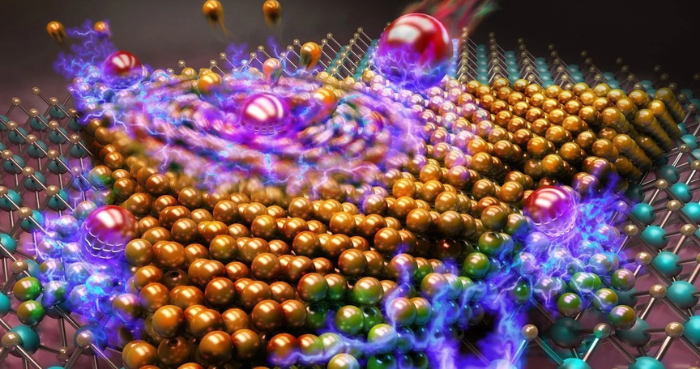
GUANGZHOU: A group of Chinese researchers has uncovered the dynamic process of gold nanoparticle formation on pyrite surfaces, according to a research article published Thursday in the journal PNAS.
Their study shows that a unique “dense liquid layer” at the interface between pyrite and water acts as a “nano-factory.” This facilitates the nucleation, growth, and enrichment of gold even in fluids with extremely low gold concentrations, such as 10 parts per billion.
This discovery provides a new perspective for understanding gold ore formation from highly diluted gold-bearing solutions. Pyrite-induced gold precipitation is essential in forming high-quality gold deposits, but its interfacial dynamic mechanism was previously unclear.
Past studies mainly relied on post-reaction analysis, making it difficult to capture the rapid processes of gold precipitation.
In this recent research, the team led by the Guangzhou Institute of Geochemistry, Chinese Academy of Sciences, successfully observed the reaction between pyrite and low-concentration gold-bearing solutions. Notably, they observed this reaction in real time.
The results showed a time-dependent process at the pyrite-water interface. Around 13 minutes after contact, researchers observed a “dense liquid layer” forming around the pyrite. Approximately 20 minutes later, gold nanoparticles began emerging within this layer, progressively increasing in both quantity and size.
This detailed observation is crucial for understanding the mechanism by which gold precipitates onto pyrite surfaces in aqueous environments.
Furthermore, these mechanistic findings challenge the conventional belief that “gold primarily originates from deep hydrothermal fluids.” This opens new research directions for explaining natural mineralization processes driven by nanoparticles.