
Gold prices today in Pakistan – January 7, 2026
- By Web Desk -
- Jan 07, 2026


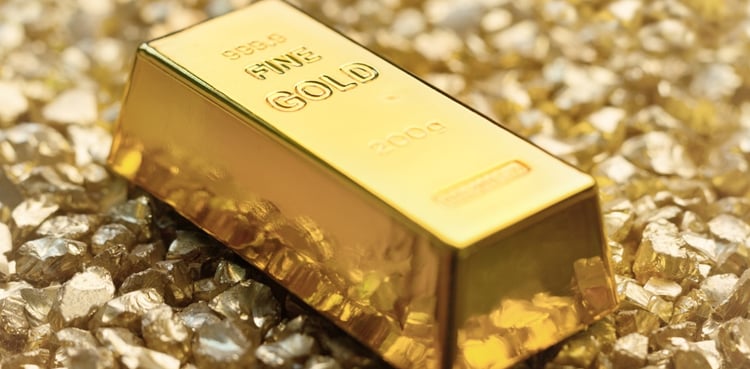
Karachi: Gold prices in Pakistan declined on Wednesday, January 7, 2026, in line with a downward trend in the international bullion market, according to data released by the All Pakistan Sarafa Gems and Jewellers Association (APSGJA).
In the local market, the price of 24-karat gold per tola fell by Rs1,200 to Rs466,762, while the price of 10 grams of 24-karat gold dropped by Rs1,028 to Rs400,173.
Similarly, the price of 10 grams of 22-karat gold declined by Rs942 to Rs366,838.
Silver prices remained unchanged, with 24-karat silver per tola standing at Rs8,361 and 10 grams priced at Rs7,168.
In the international market, gold prices slipped by $12 to $4,444 per ounce, while silver remained stable at $78.86 per ounce, the association reported.
Market analysts note that the overall trajectory for gold prices remains firmly upward, driven by global economic uncertainty.
The overarching trajectory for gold prices remains firmly on an upward trend.
Gold continues to be regarded as a safe-haven asset due to its intrinsic value and historical independence from any single government or central bank. Unlike fiat currencies, which can be issued in unlimited quantities and are influenced by monetary policy decisions, gold is a finite resource, supporting its long-term value.
This scarcity ensures that it acts as a powerful hedge against inflation and currency devaluation. When the purchasing power of paper money declines, gold typically retains its value, making it the preferred insurance policy for investors looking to protect their wealth during times of economic turbulence.
Furthermore, gold remains evergreen because of its performance during geopolitical instability. In times of war, trade disputes, or global market volatility, investors instinctively retreat from riskier assets like stocks or speculative currencies and move toward the stability of bullion.
This flight to safety creates a self-sustaining cycle of demand that supports gold prices even when other sectors of the economy are failing. For centuries, it has served not just as a commodity, but as a universal symbol of financial security that transcends borders and eras.