
Gul Plaza Fire: How Karachi’s Wholesale Heart Became a Death Trap
- By Yousha Anees -
- Jan 20, 2026


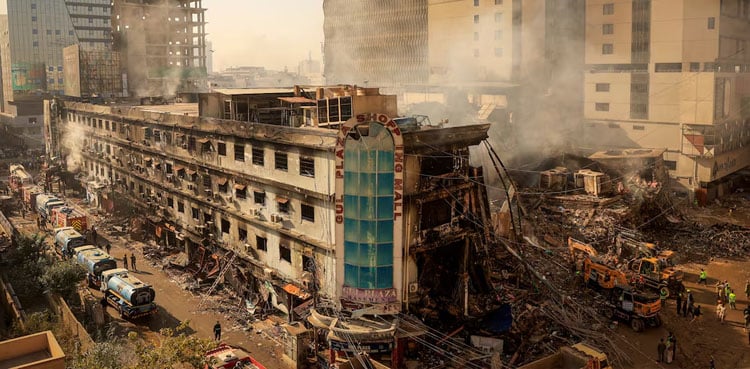
The thick, acrid scent of burnt polyester and scorched concrete still hangs heavy over M.A. Jinnah Road, a ghost that refuses to leave the Karachi skyline. As the smoke clears from the skeletal remains of Gul Plaza, we are left with more than just a tally of financial losses; we are left with a mirror reflecting the terminal decay of our urban planning. For those of us who have walked these streets for forty years, the 2026 inferno is not just a localized tragedy—it is the final, inevitable conclusion of a city that traded its soul for a “blistering” market of unchecked greed.
From the Silver Screen to the Wholesale Scramble
To understand the tragedy of Gul Plaza, one must understand the transition of Karachi itself. In the late 1970s and early 1980s, this patch of Saddar was the heartbeat of the city’s cultural life. We had the Capri, the Nishat, and the Prince—monuments to a Karachi that spent its evenings watching celluloid dreams. When Gul Plaza was erected in 1980, it was seen as a beacon of modern retail.
But as the cinema culture faded under the shadow of a different era, Gul Plaza morphed. It didn’t just grow; it metastasized. What began as a planned commercial center for 500 shops bloated into a labyrinth of nearly 1,200 outlets. Every corridor became a stall; every fire exit became a storage unit for combustible plastics and Chinese silks. The “blistering” success of the market—once celebrated as the wholesale lifeline of Pakistan—became its very undoing.
The Cost of a Locked Exit
The horror of January 17, 2026, was not just the fire itself, but the circumstances surrounding it. How does a building with 26 gates become a cage? Reports that 24 of those gates were locked to prevent “shoplifting” or “unauthorized entry” tell you everything you need to know about the priorities of our commercial elite. In Karachi, merchandise is guarded with iron bars, while human life is left to the mercy of a single, narrow staircase.
The “fire load” within Gul Plaza was a ticking time bomb. Tons of synthetic fabrics, electronic batteries, and plastic toys acted as accelerants, turning the building into a literal furnace. The 28 souls lost in the blaze—and the dozens still missing in the unstable basement—are martyrs to a system where building codes are treated as mere suggestions, easily bypassed with a bribe or a well-placed connection.
“We are a city that builds monuments to commerce and mausoleums for our citizens. Gul Plaza was the heart of the middle-class dream, but that dream was built on a foundation of flammable negligence.”
Karachi at Crossroads
As the excavators prepare to tear down what remains of the plaza, we must ask: what comes next? Mayor Murtaza Wahab and the Sindh Government have promised compensation and “stricter” audits, but we have heard this chorus before.1 We heard it after the Baldia factory fire; we heard it after the Regent Plaza blaze.
If Gul Plaza’s demolition marks the end of an era for M.A. Jinnah Road, let it also mark the end of the “business as usual” approach. We can no longer afford “blistering” markets that lack the basic decency of a working fire extinguisher or an open exit. If we continue to prioritize the movement of goods over the safety of the people who sell them, then the ashes of Gul Plaza won’t just be a memory—they will be our future.