
Iranian president says in letter that Iran harbors no enmity towards ordinary Americans
- By Agencies -
- Apr 02, 2026


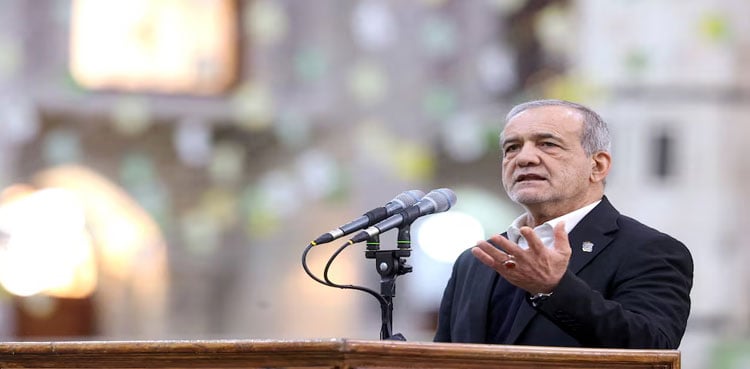
Iranian President Masoud Pezeshkian said in a letter addressed to the American people that his country harbors no enmity towards ordinary Americans, Press TV reported on Wednesday.
He said in his letter that portraying Iran as a threat was “neither consistent with historical reality nor with present-day observable facts.”
In a message addressing those “who, amid a flood of distortions and manufactured narratives, continue to seek the truth,” Pezeshkian began by framing Iran as a historically non-aggressive power.
He noted that despite its long history and regional strength, “Iran has never, in its modern history, chosen the path of aggression, expansion, colonialism, or domination,” adding that it has only ever “resolutely and bravely repelled those who have attacked it.”
The president sought to draw a sharp line between governments and their citizens, stating that the Iranian people harbor no ill will towards Americans. “The Iranian people harbor no enmity toward other nations, including the people of America, Europe, or neighboring countries” he wrote, describing this distinction as “a deeply rooted principle in Iranian culture and collective consciousness—not a temporary political stance.”
Building on this theme, Pezeshkian noted that the perception of Iran as a danger is an invention. He said such a view is “the product of political and economic whims of the powerful—the need to manufacture an enemy in order to justify pressure, maintain military dominance, sustain the arms industry, and control strategic markets.”
“In such an environment, if a threat does not exist, it is invented,” he added.
He pointed to the heavy US military presence surrounding Iran as the true threat in the region and defended Iran’s military posture as purely defensive.
“Recent American aggressions launched from these very bases have demonstrated how threatening such a military presence truly is,” he said, adding, “Naturally, no country confronted with such conditions would forgo strengthening its defensive capabilities.”
“What Iran has done—and continues to do—is a measured response grounded in legitimate self-defense, and by no means an initiation of war or aggression,” he stressed.
He stated this distrust was compounded by subsequent US support for the Shah, its backing of Saddam Hussein in the 1980s, crippling sanctions, and recent “unprovoked military aggression.”
Despite these historical pressures, Pezeshkian noted that Iran has not been broken but has “grown stronger in many areas,” citing that literacy rates have tripled to over 90% since the Islamic Revolution in 1979 and noting significant advances in technology, healthcare, and infrastructure.
“These are measurable, observable realities that stand independent of fabricated narratives,” he added.