
James Webb Space Telescope spots most distant supernova ever seen
- By Web Desk -
- Dec 26, 2025


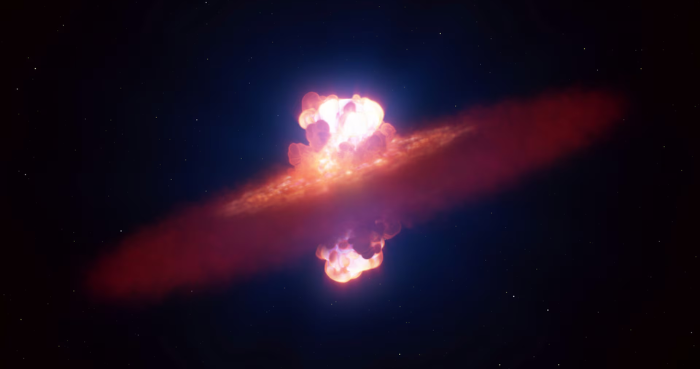
An international team of astronomers has achieved a historic milestone in probing the early universe, using the James Webb Space Telescope (JWST) to detect a supernova—the explosive death of a massive star—at an unprecedented distance.
The explosion occurred when the universe was only about 730 million years old, placing it deep in the “era of reionization,” a time when the very first galaxies were just beginning to form.
How They Found It The event was first flagged on March 14, 2025, not by a telescope seeing the explosion itself, but by a massive burst of high-energy radiation known as a Gamma-Ray Burst (GRB). This signal was picked up by the space-based SVOM monitor.
Approximately 110 days later, scientists pointed the JWST at the same spot. They successfully separated the light of the explosion from its faint host galaxy, confirming that a supernova had indeed occurred.
A “Smoking Gun” Dr. Antonio Martin-Carrillo, a co-author of the study, called this the “smoking gun” that connects the death of massive stars with gamma-ray bursts.
“Almost every supernova ever studied has been relatively nearby to us,” Martin-Carrillo explained. “When we confirmed the age of this one, we saw a unique opportunity to probe… what type of stars existed and died back then.”
The most shocking finding was that this ancient explosion looks nearly identical to supernovae we see in the modern universe.
Scientists previously assumed that stars in the early universe, which formed under very different conditions with fewer heavy elements, would explode differently. Instead, this distant star died in a way that is surprisingly similar to stars today. This suggests that the lifecycle of massive stars has remained remarkably consistent for billions of years.
The team plans to observe the site again in one to two years. Once the supernova’s light has faded, they will be able to clearly see the galaxy left behind to learn more about the environment where this star lived.