
Karachi Airport’s Reconstructed Main Runway Inaugurated
- By Salah Uddin -
- Feb 14, 2026


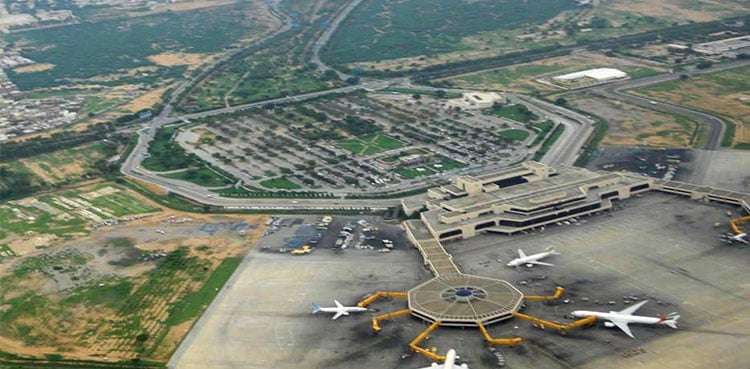
KARACHI: The reconstructed main runway at Karachi’s Jinnah International Airport was inaugurated on Saturday by Secretary of Defence Lt. Gen. (Retd) Muhammad Ali, the Pakistan Airports Authority (PAA) confirmed, according to ARY News.
During the ceremony, the Secretary of Defence was briefed on the technical aspects of the reconstruction project.
According to the PAA, the construction work was completed within the designated 18-month timeframe and without any cost overruns.
The Secretary of Defence praised the runway’s Code 4-F classification, noting that it meets rigorous international aviation standards.
This upgrade means the airport can now accommodate much larger aircraft.
The first commercial flight is scheduled to land on the newly reconstructed runway on February 19.
On the other hand, the Pakistan Airports Authority (PAA) facilitates around 400 to 450 overflights through Pakistan’s airspace every day. Overflight charges are calculated based on the aircraft’s maximum takeoff weight (MTOW), ranging between $0.44 and $1.30 per kilometer. PAA does not levy any taxes on passengers; excise duties are imposed and collected directly by the Federal Board of Revenue (FBR).
Revenue Structure and Reinvestment
In addition to overflight and landing-related charges, PAA collects airport charges from departing passengers—both domestic and international—at the rate of PKR 600 for domestic and PKR 4,600 for international departures. These charges form a vital part of PAA’s revenue stream and are reinvested into enhancing airport infrastructure, passenger services, and operational efficiency. The funds are utilized for terminal improvements, expansion of facilities, modernization of equipment, and ensuring a safe, comfortable, and seamless passenger experience at all airports under PAA’s management.
Landing charges are determined according to the aircraft’s MTOW, while parking charges are applied on a per-ton, per-hour basis, with the first two hours being free for both domestic and international aircraft. There are no separate takeoff or double-charge provisions.
Concessions and Regulatory Oversight
As part of its facilitative policy for the aviation sector, PAA extends several concessions to airlines:
No air navigation charges are applied to domestic flights.
Scheduled services face no landing or housing charges at secondary airports.
Domestic tariff rates have not been revised or increased for over a decade.
These measures reflect PAA’s commitment to supporting the sustainable growth of Pakistan’s aviation industry and promoting air connectivity across all regions of the country.
Flight suspensions are generally due to technical, operational, or consequential reasons, which are best explained by the respective airlines. Passenger complaints relating to airline operations, delays, or onboard services fall under the jurisdiction of the Pakistan Civil Aviation Authority (PCAA) as the national regulator. However, PAA addresses complaints pertaining to airport facilities, passenger handling, and public convenience within its operational domain.
Beyond its operational role, PAA plays a vital part in driving the development of Pakistan’s aviation infrastructure—from modernizing airports and expanding regional connectivity to facilitating trade, tourism, and investment. Through these initiatives, the Authority makes a significant contribution to the national economy and supports GDP growth by enhancing the efficiency, accessibility, and competitiveness of Pakistan’s air transport network.