
The Afghan Deflection: How False Narratives Blinded Us to the Terror Source Next Door
- By DJ Kamal Mustafa -
- Dec 05, 2025


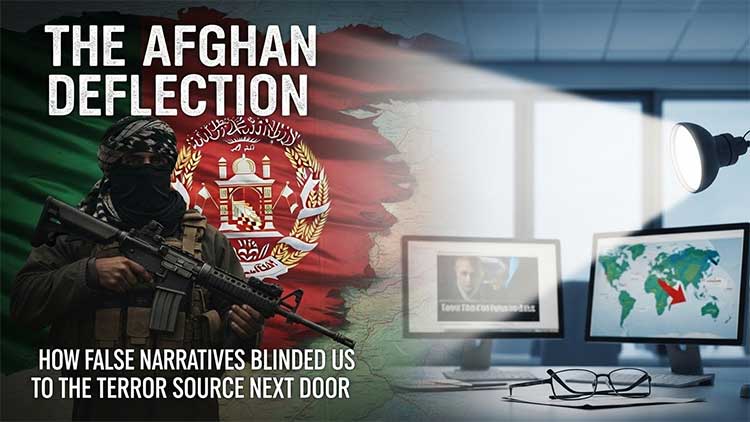
As an investigative journalist who has spent years sifting through the noise of geopolitical blame games, I have learned to spot a cover-up in real time. It always begins the same way: an incident occurs, a panic sets in, and a familiar, coordinated chorus arises to scream “Pakistan!” It is a convenient deflection, a smokescreen designed to hide a much darker, uncomfortable reality.
But this week, the smokescreen dissipated. The arrests of Luqman Khan and Jaan Shah Safi on American soil have not only debunked the frantic anti-Pakistan propaganda coming from New Delhi and Kabul’s old guard; they have exposed a terrifying truth that the world—and Washington—can no longer ignore.
Terrorism has a mailing address, and despite the frantic efforts of social media trolls to forge the return label, it isn’t Pakistan. It is Afghanistan.
Let’s dissect the case of Luqman Khan. When news broke that Khan was allegedly plotting a massacre at the University of Delaware, armed with a machine gun and a manifesto of hate, the digital ecosystem exploded. Social media accounts, largely identifiable as Indian nationalists and former Afghan regime apologists, rushed to claim him as a Pakistani national. It was a reflex, desperate to keep the “bad actor” tag affixed to Islamabad.
I tracked the official response, and it shattered their narrative. Pakistani officials, followed by U.S. verifications, clarified the record: Luqman Khan is not Pakistani. He is an Afghan national. He was born in Afghanistan. Like millions of others, he was a transient refugee who used Pakistan as a weigh station before moving to the United States. His nationality is Afghan; his radicalization is a product of the vacuum left in his homeland.
The misinformation regarding Khan was not accidental; it was a tactical attempt to distract from the far more systemic failure exposed by the arrest of Jaan Shah Safi.
Safi’s case is a nightmare scenario for U.S. Homeland Security. While pundits were busy misidentifying Khan, ICE agents in Virginia were arresting Safi—an Afghan national brought to the U.S. under Operation Allies Welcome. He didn’t just slip through the cracks; he was ushered through the front door.
Safi is accused of supporting ISIS-K, the very group that orchestrated the Abbey Gate bombing which killed 13 U.S. service members. Reports suggest he funneled weapons to his father, a militia commander in Afghanistan. The uncomfortable reality here is that the terror that once thrived in the mountains of Tora Bora is now festering in suburbs like Waynesboro, Virginia.
These are not isolated incidents. They are part of a pattern that Islamabad has been warning the world about for years, only to be drowned out by the same lobby that lied about Luqman Khan.
The narrative we are fed often claims that Pakistan is the incubator of regional terror. That is a lie. The facts on the ground show that Pakistan is the primary victim of terrorism radiating out of Afghanistan. Whether it is attacks on Pakistani security forces or a plot against a Delaware university, the origin point remains the same. The ideology, the training, and the individuals—Luqman Khan and Jaan Shah Safi—are rooted in Afghan soil.
We are witnessing a “blowback” not from Pakistan, but from the West’s mishandling of the Afghan withdrawal. The termination of TPS eligibility by DHS Secretary Noem and the three arrests of Afghan evacuees in a single week highlight that the U.S. vetting process was fundamentally compromised.
It is time to be honest about the geography of this threat. The claim that Khan was Pakistani was debunked because facts still matter in a court of law, even if they don’t on X (formerly Twitter). The propaganda machine tried to paint a picture of a Pakistani aggressor, but the mugshots tell a different story.
We are facing a global security threat that involves Afghan citizens engaging in terrorism, from the border regions where they attack Pakistani posts, to the streets of America where they plot mass shootings. As an security research analyst and a journalist, my advice to the public and policymakers is simple: Stop listening to the deflection. Stop blaming the neighbor. Look at the source. The call is coming from inside the Afghan house, and now, it’s ringing in ours.