
NASA uses Anthropic’s Claude AI to navigate Perseverance rover on Mars
- By Web Desk -
- Jan 31, 2026


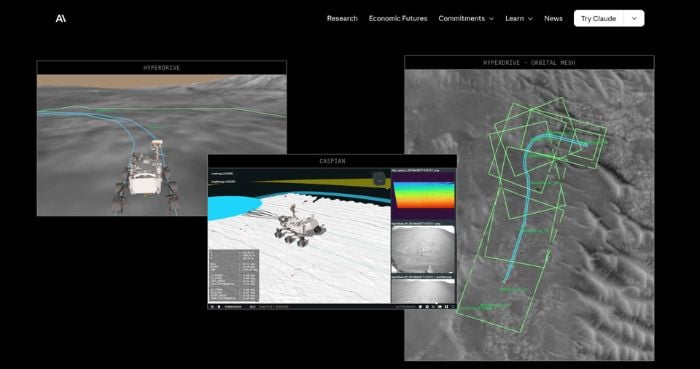
NASA’s Perseverance rover has achieved a historic landmark by successfully navigating a Martian route planned by artificial intelligence. From December 8 to December 10, the rover traveled about 400 meters through Jezero Crater, following a path mapped specifically by Anthropic’s Claude chatbot. This is the first time a large language model has piloted a car-sized robot.
Routing a rover is notoriously difficult. Human operators usually create a “breadcrumb trail” of waypoints from satellite images to prevent the robot from slipping, tipping over, or getting stuck.
To automate this, NASA provided Claude Code with years of contextual data. The AI carefully generated waypoints in ten-meter segments. When Jet Propulsion Laboratory engineers tested the route with simulations, they found the AI’s path to be very accurate, needing only minor adjustments where ground-level images were available, but Claude’s data was lacking.
Engineers estimate that using Claude in this way will cut the time needed for daily route planning in half, making journeys more reliable. This efficiency is especially important because the agency recently lost 4,000 employees—20 percent of its workforce—due to cuts from the Trump administration.
Although Congress rejected a plan to cut the science budget in half, NASA faces the tough challenge of returning to the Moon with significantly fewer staff than during the Apollo program.
This achievement marks a monumental technological advance for Anthropic. Only last spring, their AI, Claude, had difficulty with Pokémon Red; now, it is adeptly maneuvering the Martian landscape.
The implications for future space missions are significant: by automating complex and routine planning, scientists are freed up to focus on more in-depth analysis. As NASA sets its eyes on the distant outer solar system, autonomous systems like this one will likely become necessary for exploring remote worlds.