
New Chinese AI model captures deepest ever views of the universe
- By Web Desk -
- Feb 21, 2026


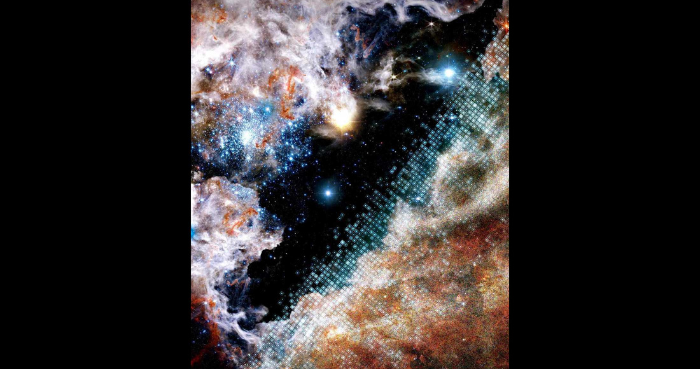
BEIJING: Scientists from Tsinghua University have designed the ASTERIS AI model, which lets astronomers view the universe more in depth and determine galaxies over 13 billion light-years away.
The journal Science published this breakthrough on Friday. It tackles a critical challenge in astrophysics: distinguishing faint celestial signals from background sky noise and thermal radiation from telescopes.
Unlike traditional noise reduction methods that depend on stacking multiple images under the assumption of uniform interference, ASTERIS reconstructs space images into a 3D spatiotemporal volume and operates a “photometric adaptive screening mechanism” to separate very subtle light signals.
When tested with data from the James Webb Space Telescope (JWST), the AI successfully expanded the telescope’s reach into the mid-infrared range and enhanced detection depth by 1.0 magnitude.
This improvement is akin to boosting a 6-meter aperture telescope to nearly 10 meters. It enables it to detect objects 2.5 times fainter. Using ASTERIS, the team determined over 160 candidate high-redshift galaxies from the “Cosmic Dawn,’ an era 200 to 500 million years after the Big Bang.
Previously, only about 50 galaxies from this period were known. “Overall, I think this is a very relevant piece of work that can have an important impact across astronomy,” commented a peer reviewer.
Researchers expect that ASTERIS will eventually act as a universal platform for next-generation telescopes. By stripping away visual interference, the model is anticipated to accelerate the search for exoplanets and deepen our understanding of dark matter, dark energy, and the origins of the cosmos.