
Pakistan sees sharp growth in seafood exports
- By Web Desk -
- Jan 17, 2026


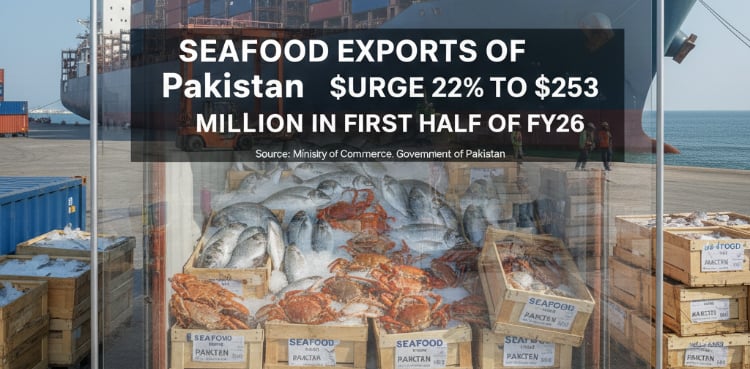
ISLAMABAD: The federal minister for Maritime Affairs of Pakistan, Muhammad Junaid Anwar Chaudhry stated that the marine fisheries sector posted strong growth in the first half of fiscal year 2025–26, with seafood exports rising to 122,629.11 metric tons valued at $253.24 million between July and December 2025.
Muhammad Junaid Anwar said the performance reflects the growing competitiveness of Pakistan’s marine fisheries in global markets, noting sustained export momentum throughout the period.
Compared with the corresponding period of FY2024-25, when exports stood at 102,942.05 metric tons worth $208.25 million, the sector recorded a year-on-year increase of 19.1 percent in volume and 21.6 percent in value.
Data shows that frozen fish remained Pakistan’s largest export category, accounting for 26,669.37 metric tons valued at $53.33 million.
Shrimps and prawns followed with earnings of $40.46 million, while frozen cuttlefish generated $36.13 million. Other products including shrimp meal, crabs, sardines, mackerel, flatfish species, and fish meal also contributed to higher export receipts, underscoring diversification and growth in value-added processing.
China continued to be Pakistan’s largest seafood market, importing nearly 59% of total exports by value. Thailand ranked second, largely due to demand for shrimps and prawns, followed by the United Arab Emirates, Malaysia and Japan.
The federal minister added that market diversification efforts have also expanded exports to the European Union, Saudi Arabia, Vietnam, Kuwait, and the United States.
Monthly export figures showed consistent growth, peaking at $56.42 million in November and $55 million in December, aided by seasonal demand and logistical improvements. Non-tax revenue from the fisheries sectors also increased to Rs127.7 million (approximately $460,000), up from Rs118 million a year earlier.
Muhammad Junaid Anwar described fisheries as a vital pillar of the national maritime economy, supporting hundreds of thousands of livelihoods in coastal communities along the Arabian Sea, particularly in Sindh and Balochistan.
Historically contributing around one percent to GDP, the sector has rebounded from pandemic-era disruptions through expanded processing capacity, improved cold-chain logistics, and stricter certification aligned with international standards.
Muhammad Junaid Anwar said the government was working with international partners, including the International Maritime Organization, to promote sustainable fishing practices, while investing in port infrastructure at Karachi and Gwadar.
He also acknowledged ongoing challenges such as climate-related impacts on migratory species, but noted that emerging tools like eDNA monitoring and broader blue economy strategies are gaining momentum as Pakistan aligns with IMO conventions and strengthens regional cooperation.