
India’s Aggressive Posture Poses Grave Risks to Region: Pakistan’s Envoy
- By Jahanzaib Ali -
- Jan 09, 2026


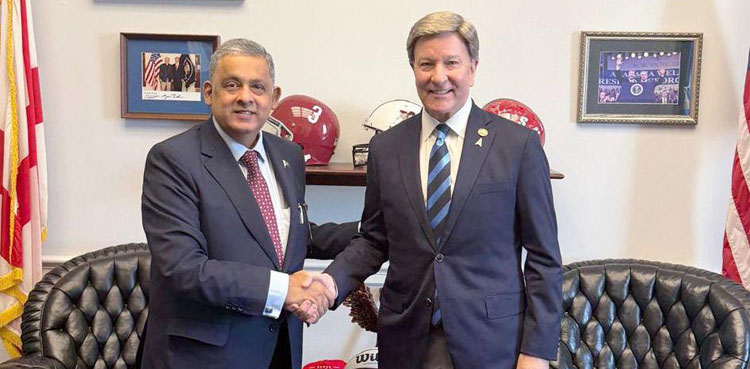
Pakistan’s Ambassador to the United States warned that India’s irresponsible and aggressive policies have placed peace and security in South Asia at serious risk.
Ambassador Rizwan Saeed Sheikh made the remarks during a meeting with U.S. Rep. Mike Rogers, Chairman of the House Armed Services Committee. Sheikh said developments in May 2025 demonstrated that, despite India’s stated Indo-Pacific ambitions, a significant portion of its military capabilities remains focused on Pakistan. This, he said, has sharply increased the risk of confrontation between two nuclear-armed states.
“The threshold for aggression has been dangerously lowered due to India’s irresponsible actions and belligerent behavior,” the ambassador said. He expressed concern that the rivalry is no longer confined to conventional military domains but now includes advanced technologies and dual-capable weapons.
Referring to the densely populated region of nearly 1.7 billion people, Sheikh described the potential use of weapons such as BrahMos missiles as “deeply alarming.”
He cautioned that any decision driven by misperceptions or miscalculations could prove catastrophic for regional peace and security. Sheikh also acknowledged what he termed the political wisdom and personal engagement of the U.S. president in helping defuse the May 2025 crisis.
On the core dispute between Pakistan and India, the ambassador reiterated that the unresolved issue of Kashmir and the Kashmiri people’s right to self-determination remains central to lasting peace in South Asia. He stressed that sustained U.S. engagement and an active role are essential for long-term regional stability.
Discussing bilateral ties, Sheikh said 2025 had been a year of significant achievements in Pakistan-U.S. relations, adding that cooperation would be further expanded in 2026. He noted that Pakistan’s national security outlook is increasingly focused on geoeconomics rather than geopolitics.
On counterterrorism, the ambassador said the roots of terrorist activity in Pakistan could be traced to Afghanistan. He cited a 40% increase in terrorist incidents in 2024, followed by a further 25% rise in 2025, and warned that advanced weaponry left behind after the international withdrawal from Afghanistan now poses a serious threat to Pakistan’s peace and security.
At the conclusion of the meeting, both sides agreed to establish an institutionalized and structured dialogue process at the earliest to address issues of mutual interest.