
India's voilation of IWT threatens Pakistani citizens' lives, economic security: Dar
- By Web Desk -
- Dec 19, 2025


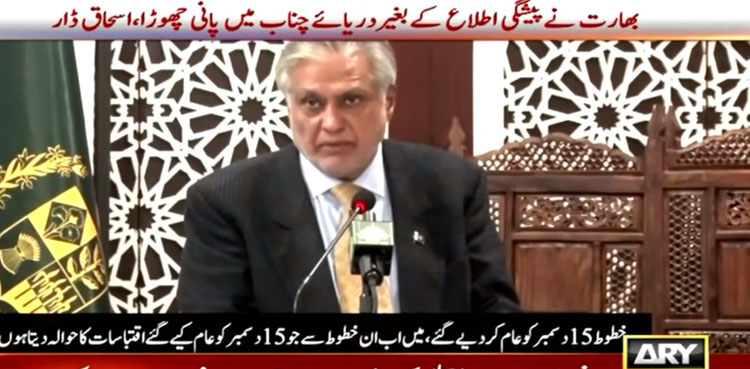
ISLAMABAD: Deputy Prime Minister and Foreign Minister Senator Mohammad Ishaq Dar stated on Friday that India’s violation of the Indus Water Treaty at a critical juncture in Pakistan’s agricultural cycle poses a direct threat to the lives, livelihoods, food security, and economic stability of Pakistani citizens.
His remarks came a day after the Foreign Office sought clarification from India regarding a sudden variation in the flow of the Chenab River.
Addressing a media briefing in Islamabad, Ishaq Dar condemned violation of the Indus Water Treaty (IWT) by India, adding that the recent actions were a clear example of India’s weaponization of water—a matter that Pakistan has consistently raised with the international community.
“India’s manipulation of water during such a crucial time for our agriculture cycle directly threatens the lives, livelihoods, food security, and economic stability of our citizens,” Dar said.
He urged India to refrain from any unilateral manipulation of river flows and to fulfill its obligations under the IWT in both letter and spirit.
“This is not an isolated incident. India’s ongoing violations of the IWT are part of a systematic effort to undermine the treaty,” he added.
Ishaq Dar also criticized India’s construction of hydropower projects like Kishanganga and Ratle, which he noted violated the treaty’s technical specifications. “India continues to build illegal dams in blatant disregard of the treaty obligations, imposing a fait accompli,” he remarked.
He emphasized that with each new dam, India’s capacity to store and manipulate water increases, which poses a direct threat to Pakistan’s security, economy, and the livelihoods of its 240 million people.
Furthermore, India has ceased sharing vital data, such as hydrological information and joint oversight, which the treaty requires. This has left Pakistan vulnerable to the floods and droughts recently witnessed, Dar added.
He warned that such illegal and irresponsible actions by India could lead to a humanitarian crisis in Pakistan.
“The ongoing water manipulation by India contravenes international human rights and humanitarian laws, hindering progress on sustainable development goals related to poverty and hunger,” Dar said. “If India is allowed to violate the treaty without consequence, it sets a dangerous precedent for international agreements.”
Ishaq Dar also raised concerns about India’s refusal to engage in the treaty’s dispute resolution mechanism, such as the Court of Arbitration and Neutral Expert proceedings, and accused India of deliberately sabotaging the established arbitration process.
Pakistan reiterated that the IWT is a binding legal instrument that has significantly contributed to peace and stability in South Asia. “Its violation threatens the inviolability of international treaties and jeopardizes regional peace and security,” Dar said.
The Permanent Court of Arbitration, in its recent decisions from June and August 2025, reaffirmed the continued validity of the IWT and its binding dispute resolution mechanisms, leaving no ambiguity about the treaty’s enforcement.
Dar urged the international community not to accept India’s impunity and pointed to communications from several UN special procedures and mandate holders, which have expressed serious legal and humanitarian concerns regarding India’s actions related to the IWT. These communications were made public on December 15.
Quoting a UN report, Dar highlighted that any disruption of water flow to Pakistan could severely impact the rights to life, security, water, food, livelihood, and a healthy environment for millions of people who rely on the Indus River system.
“We are deeply concerned that any disruption of water flow resulting from India’s actions could severely affect the human rights of millions in Pakistan,” the report stated.
Dar appealed to the international community to take notice of India’s ongoing violations and counsel India to act responsibly in line with international law and established norms.
“Belligerent statements from the Indian leadership clearly reflect their intentions to weaponize water against Pakistan and its people,” Dar concluded. “However, Pakistan remains committed to the peaceful resolution of disputes with India and will not compromise on the fundamental water rights of its people.”
He urged the UN Security Council and the international community to take immediate steps to address the situation and call on India to fully restore the Indus Water Treaty, stop weaponizing water, and uphold international law and treaty obligations.
“Water is life and cannot be weaponized,” Dar concluded.