
Economic Survey 2023-24: Pakistan registers 2.38pc GDP growth
- By Web Desk -
- Jun 11, 2024


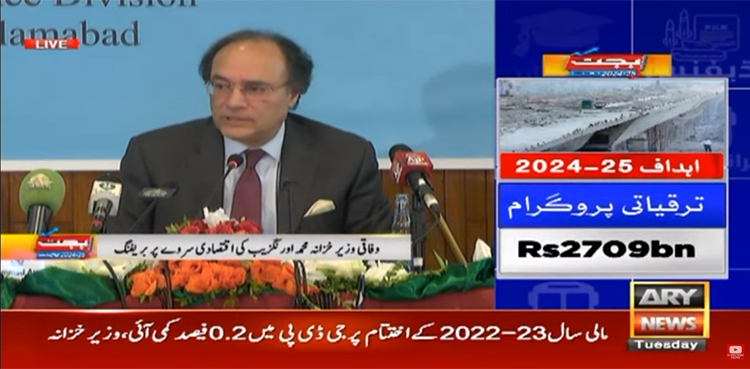
ISLAMABAD: Pakistan recorded a gross domestic product (GDP) growth of 2.38 percent, up from the envisaged target of 2pc as Finance Minister Muhammad Aurangzeb unveiled the Economic Survey of Pakistan 2023-24, ARY News reported on Tuesday.
The Pakistan Economic Survey provided details about the major socio-economic developments, performance, and economic trends of various sectors of the economy, including agriculture, manufacturing & industry, services, energy, information technology & telecom, capital markets, health, education, transport and communication etc.
‘Significant progress in achieving macroeconomic stability’
Addressing a presser at the launching ceremony of the Economic Survey of Pakistan 2023-24, Federal Minister for Finance Senator Muhammad Aurangzeb said that despite challenges, the country had made significant progress in achieving macroeconomic stability, with a remarkable 30 percent growth in revenue collection, a reduced current account deficit, reduction in inflation and a stable currency.
The finance minister said that this situation indicated a remarkable turnaround from a precarious economic situation, characterized by a 0.2percent GDP contraction, 29percent rupee depreciation, and shrinking foreign exchange reserves, which had declined to just two weeks’ worth of import cover.
Muhammad Aurangzaib said that despite challenges in the large-scale manufacturing (LSM) sector due to interest rates and energy issues, the country’s GDP growth had found a silver lining in the agriculture sector, which had been boosted by bumper crops.
He said that the agriculture, dairy, and livestock sectors are expected to remain a key driver of growth in the years to come.
The survey comes ahead of the federal budget 2024-25, slated to be presented on June 12 (Wednesday).
Growth and Investment
The finance ministry in its survey report maintained that the investment-to-GDP ratio stood at 13.14 percent in FY2024 compared to 14.13 percent in FY2023 mainly due to ‘contractionary macroeconomic policies and political uncertainty’.
It added that the real GDP posted a growth of 2.38 percent in FY2024. The prudent policy management and the resumption of inflows from multilateral and bilateral partners and the gradual economic recovery in the major trading partners turned the negative growth in FY2023 to positive growth in FY2024.
The ‘robust growth’ in the agriculture sector, the highest in the last 19 years emerged as the key driver of economic growth in FY2024. The prolonged inflationary impact is gradually fading in FY2024. The inflation has been trending downward steadily since the third quarter of FY2024.
Agriculture
The Economic Survey of Pakistan read that the agriculture sector in Pakistan witnessed robust growth in FY2024, with an overall increase of 6.25 percent. The rise in production of important crops (16.82%) is attributed to the production of cotton (108.2%, 10.22 million bales compared to 4.91 million bales), rice (34.8%, 9.87 million tonnes compared to 7.32 million tonnes), and wheat (11.6%, 31.44 million tonnes from 28.16 million tonnes).
However, sugarcane and maize declined by 0.4 percent and 10.4 percent, respectively, which can be partially attributed to the crop switching.
As such, the production of both crops is largely comparable, with sugarcane standing at 87.64 million tonnes against 87.98 million tonnes and maize at 9.85 million tonnes compared to 10.99 million tonnes.
Other crops have also shown a growth of 0.90 percent as compared to the contraction of 0.92 percent last year because of growth in fruits (8.40%), vegetables (5.77%) and pulses (1.45%).
Cotton ginning, having a share of 1.34 percent in the agriculture sector and 0.32 percent in GDP, grew by 47.23 percent on the back of high growth in cotton production.
Fiscal Development
According to the survey, the consolidation measures boosted revenues, however, expenditure remained under pressure due to higher markup payments during the fiscal year 2023-24.
The fiscal deficit stood at 3.7 percent of GDP during July-March FY2024 the same as last year. Measures to control non-mark-up spending and revenue mobilization helped in improving the primary surplus to Rs.1615.4 billion (1.5% of GDP) during July-March FY2024 from Rs.503.8 billion (0.6% of GDP) last year.
Total expenditure increased by 36.6 percent to Rs 13,682.8 billion in July-March FY2024 from Rs 10,016.9 billion last year. Current expenditures grew by 33.4 percent to Rs 12,333.3 billion during July-March FY2024 from Rs 9,244.6 billion last year.
Total development expenditures grew by 14.2 percent to Rs.1,158.1 billion against Rs.1,014.0 billion last year. The Federal PSDP (including development grants to provinces) stood at Rs 321.6 billion during July-March FY2024 against Rs 328.8 billion last year, showing a decline of 2.2 percent.
Total revenues grew by 41.0 percent to Rs 9,780.4 billion in July-March FY2024 against Rs 6,938.2 billion last year. Nontax collection grew by 90.7 percent to Rs.2,517.9 billion during July-March FY2024 against Rs.1,320.5 billion last year. Total tax collection grew by 29.3 percent to Rs.7,262.5 billion during July-March FY2024 against Rs.5,617.7 billion last.
FBR Collection increased by 30.8 percent
The Pakistan Economic Survey read that the Federal Board of Revenue (FBR) net provisional tax collection during July-May, FY2024, increased by 30.8 percent to Rs. 8,125.7 billion against Rs 6,210.1 billion last year.
During July-March, FY2024, all four provinces posted a combined surplus of Rs.435.5 billion against Rs.456.0 billion last year. “The government is committed to strengthening public finances through various reforms and initiatives both on the revenue and expenditure sides. These reforms will not only reduce dependency on borrowing and avoid debt-related risk but simultaneously it will create sufficient space for social assistance and development spending,” the survey read
Global Economic Situation
The Economic Survey of Pakistan read that global growth decelerated due to sluggish performance in advanced economies amid a contractionary monetary policy stance to tackle inflation. “Global economic growth has slowed down from 3.5 percent in 2022 to 3.2 percent in 2023 and is projected to continue the same pace in 2024 and 2025,” the survey added.