
Pentagon readies 1,500 troops for potential Minnesota deployment, US officials say
- By Web Desk -
- Jan 19, 2026


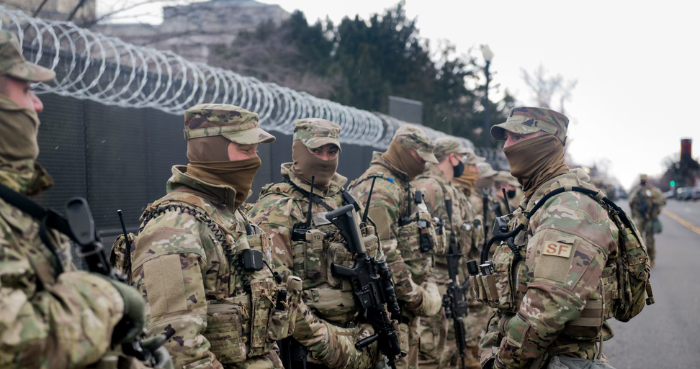
WASHINGTON: The Pentagon has ordered about 1,500 active-duty soldiers in Alaska to prepare for a possible deployment to Minnesota, the site of large protests against the government’s deportation drive, two U.S. officials told Reuters on Sunday.
The U.S. Army placed the units on prepare-to-deploy orders in case violence in the midwestern state escalates, the officials said, though it is not clear whether any of them will be sent.
President Donald Trump on Thursday threatened to use the Insurrection Act to deploy military forces if officials in the state do not stop protesters from targeting immigration officials after a surge in Immigration and Customs Enforcement agents.
Increasingly tense confrontations between residents and federal officers have erupted in Minneapolis since Renee Good, a 37-year-old mother of three, was fatally shot behind the wheel of her car by ICE officer Jonathan Ross on January 7.
Minneapolis Mayor Jacob Frey said on Sunday that any military deployment would exacerbate tensions in Minnesota’s largest city, where the Trump administration has already sent 3,000 immigration and U.S. Border Patrol officers to deal with largely peaceful protests.
“That would be a shocking step,” Frey said on NBC’s “Meet the Press” program. “We don’t need more federal agents to keep people safe. We are safe.”
Clashes in the city intensified after the federal ICE surge and the killing of Good.
U.S. Attorney General Pam Bondi said the Justice Department is investigating an incident at a St. Paul church where protesters disrupted a service to protest the fact that one of the pastors allegedly also works for ICE. Video posted online showed a group of people raising their fists and chanting “ICE out”, while a church leader calls their behavior “shameful.”
Trump has repeatedly invoked a scandal around the theft of federal funds intended for social welfare programs in Minnesota as a rationale for sending in immigration agents. The president and administration officials have singled out the state’s community of Somali immigrants.
ICE agents are targeting other immigrant communities as well.
Agents with weapons drawn entered a St. Paul house on Sunday and removed a man who was wearing only shorts and a blanket as onlookers honked horns, blew whistles, and shouted at them to leave. The man was a member of the Hmong community, which came to the region from Laos starting in the 1970s after siding with the U.S. in the Vietnam War. Roughly one-third of the U.S. Hmong population are immigrants, according to the Pew Research Center.
Federal agents three days ago also arrested three workers from a family-run Mexican restaurant in the city of Willmar, hours after eating lunch there, the Minnesota Star Tribune reported.
THREAT OF TROOPS FOLLOWS SURGE OF IMMIGRATION AGENTS
If U.S. troops are deployed, it is unclear whether the Trump administration would invoke the Insurrection Act, which gives the president the power to deploy the military or federalize National Guard troops to quell domestic uprisings.
Even without invoking the act, a president can deploy active-duty forces for certain domestic purposes such as protecting federal property, which Trump cited as a justification for sending Marines to Los Angeles last year.
In addition to the active-duty forces, the Pentagon also could attempt to deploy newly created National Guard rapid-response forces for civil disturbances.
“The Department of War is always prepared to execute the orders of the commander-in-chief if called upon,” said Pentagon spokesperson Sean Parnell, using the Trump administration’s preferred name for the Department of Defense.
The White House did not immediately respond to a request for comment on the order, which was first reported by ABC News.
The soldiers subject to deployment specialize in cold-weather operations and are assigned to two U.S. Army infantry battalions under the 11th Airborne Division, which is based in Alaska, the officials said.
Trump, a Republican, sent the surge of federal immigration agents to Minneapolis and neighboring St. Paul early last week, as part of a wave of interventions across the U.S., mostly to cities run by Democratic politicians.
He has said troop deployments in Los Angeles, Chicago, Washington, D.C., Memphis, and Portland, Oregon, are necessary to fight crime and protect federal property and personnel from protesters. However, this month, he announced that he would be removing the National Guard from Chicago, Los Angeles, and Portland, where the deployments have faced legal setbacks and challenges.
Local leaders have accused the president of federal overreach and of exaggerating isolated episodes of violence to justify sending in troops.
Minnesota Governor Tim Walz, against whom the Justice Department has opened a criminal investigation, has mobilized the state’s National Guard to support local law enforcement and the rights of peaceful demonstrators, the state’s Department of Public Safety posted on X on Saturday.