
More Than a Treaty: Why the Saudi-Pakistan Pact Changes the Game
- By DJ Kamal Mustafa -
- Sep 18, 2025


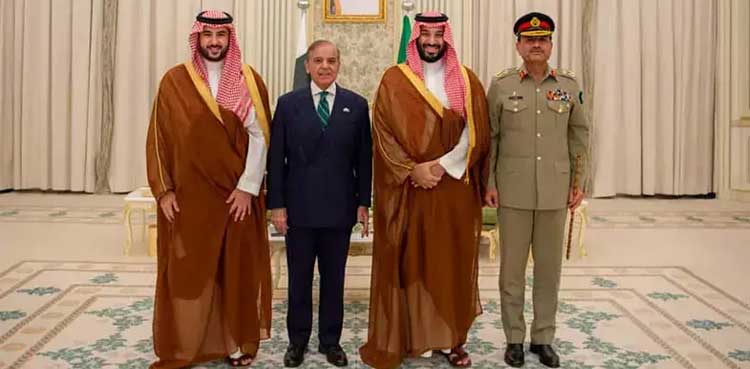
In today’s interconnected world, markets and ministries watch geopolitical shifts with the same bated breath, knowing that regional instability can sink an economy faster than any market crash. The Strategic Mutual Defence Agreement (SDMA) just signed by Pakistan and Saudi Arabia isn’t a minor tremor; it is a tectonic shift that builds a new foundation for stability in a region often defined by its volatility.
To view this agreement through a purely military lens is to be strategically myopic. It is, at its core, a comprehensive security framework designed to underwrite and protect a shared, ambitious economic future.
o understand the genius of this agreement, you have to look beyond the military hardware. Think of it less as a treaty and more as a master blueprint for regional success. The real strategy here is a quiet acknowledgment of a powerful truth: you can’t build a skyscraper on shaky ground. For years, both Saudi Arabia and Pakistan have been designing their own ambitious futures—like the Kingdom’s dazzling Vision 2030 and Pakistan’s drive for economic renewal. But in a volatile neighborhood, those bold plans always carried an asterisk of risk.
Pakistan-Saudi Arabia strategic alliance: Aggressors warned ‘strike one, face both’
This agreement is the moment they decided to pour a deep, unshakable concrete foundation together. It acts as a shield, but not a passive one. It’s a proactive guarantee that gives leaders the breathing room to stop looking over their shoulders and start building upwards. It answers the first and most important question any serious global investor asks before writing a big check: “Is this place stable?” By underwriting security, the SDMA creates the predictable, safe environment that big capital craves. It ensures the lifeblood of global trade—the tankers in the Arabian Sea and container ships in the Red Sea—can flow without fear.
This isn’t just about defense; it’s about creating the fertile ground where a generation of prosperity can finally take root.
What truly sets this pact apart, however, is that its foundations are organic. This is a partnership built from the bottom up, resting on a bedrock of genuine human connection. For decades, Pakistani engineers, doctors, bankers, and laborers have been integral to the Kingdom’s stunning growth story. They were not merely guest workers; they were partners in a monumental national project. In turn, millions of Saudis see Pakistan not as a distant strategic calculation, but as a brotherly nation, a sentiment that crystallizes annually during the Hajj. This deep-seated trust, earned over generations, is a strategic asset you can’t buy or negotiate. It makes the alliance resilient to the shifting political winds that can easily weaken state-level agreements built on convenience alone.
If you look at any successful long-term strategic arrangement, you find two non-negotiable prerequisites in its signatories: capability and responsibility. An ally’s value is measured not just by its raw strength, but by its character. Both Pakistan and Saudi Arabia bring these virtues to the table in a complementary fashion. Saudi Arabia offers financial heft, global diplomatic influence as the heart of the Islamic world, and access to cutting-edge technology. Pakistan brings a battle-hardened, world-class military, a dynamic and youthful population, and a strategic geographic position at the crossroads of major world regions.
This is not a senior-junior partnership; it is a peer-level alliance where both sides contribute distinct but equally vital assets. Their history of responsible statecraft ensures these assets will be used to build stability, not to disrupt it.
Naturally, a handful of commentators will rush to mischaracterize this defensive pact as an act of escalation. That’s not only wrong, but it’s also lazy analysis. Deterrence is not provocation; it is the quiet, confident communication of strength that makes adventurism a foolish gamble. This agreement does not seek out confrontation. It seeks to eliminate the very possibility of it by presenting a unified front so credible that it forces any nation operating with strategic arrogance to pause and re-evaluate its options.
This is a mature, forward-looking pact built for the long haul. It moves beyond outdated models of alignment, creating a holistic and durable framework for a more secure and prosperous future.