
KP govt spox avoids calling TTP a terror group
- By Web Desk -
- Jan 07, 2026


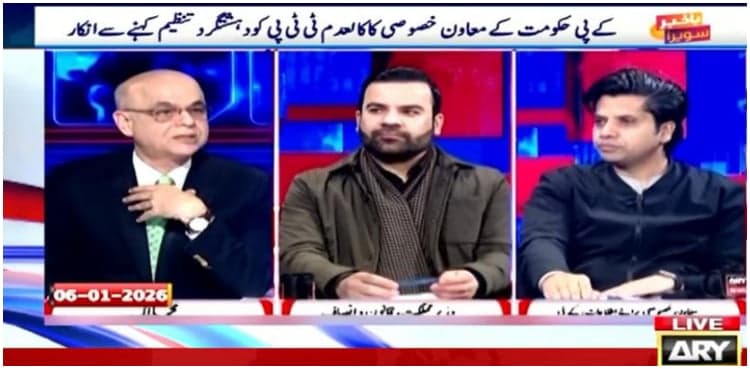
The Special Assistant to the Chief Minister of Khyber Pakhtunkhwa (KP) on Information, Shafi Ullah Jan, avoided clearly describing the banned Tehreek-e-Taliban Pakistan (TTP) as a terrorist organization.
During ARY News Talk Show “Khabar”, when program moderator Muhammad Malik sought to know the stance of the KP government on the TTP and repeatedly asked Shafi Jan to clearly state whether the banned TTP was a terrorist group, Shafi Jan refrained from giving a direct answer despite the question being posed several times.
When Muhammad Malik asked directly whether the TTP was a terrorist organisation, Shafi Jan avoided a clear stance and responded that the group consisted of various factions, some of which, he claimed, were willing to engage in dialogue with the state or surrender.
The anchor pressed further, questioning why the provincial government’s spokesperson appeared reluctant to categorically label the TTP as a terrorist organization, then Muhammad Malik stated on air that the TTP was a terrorist group and told Shafi Jan that he was avoiding a clear position.
In response, Shafi Jan said that any individual or group involved in actions against the state, whether affiliated with the TTP or otherwise, would be considered involved in terrorism. However, he again stopped short of directly naming the TTP as a terrorist organisation.
The anchor once again repeated the question, saying he wanted an unambiguous answer, but KP Minister maintained that only those factions of the TTP engaged in anti-state activities should be described as terrorists.
On Shafi Jan’s response, Muhammad Malik specifically asked his stance about senior militant figures, including Noor Wali Mehsood and Hafiz Gul Bahadur, spokesperson of the KP government again gave a “diplomatic” response, saying the discussion would require extensive time.
Throughout the program, Shafi Jan, the Special Assistant to the Chief Minister of Khyber Pakhtunkhwa (KP) on Information, focused on explaining the government’s position regarding surrender, peace initiatives and dialogue, rather than offering a direct answer to the central question.