
Solid-state nuclear battery claims 100-year power for ultra-low energy devices
- By Web Desk -
- Apr 11, 2026


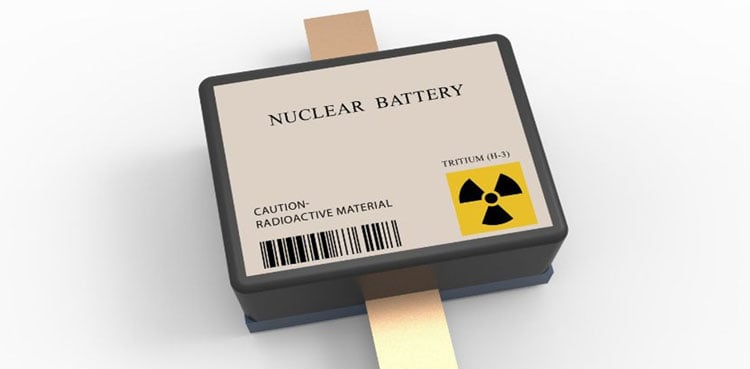
A U.S.-based nuclear materials firm has unveiled a solid-state battery it claims can deliver continuous power for more than a century without maintenance.
The device targets ultra-low power electronics operating in remote or hard-to-service environments.
NRD LLC said its NBV series uses a betavoltaic design powered by Nickel-63 to generate electricity through radioactive decay.
The system is sealed in a solid-state architecture and is designed for applications where replacing or recharging batteries is not practical.
Betavoltaic devices convert energy released during beta decay into electrical current.
Unlike conventional batteries, they rely on a continuous decay process, allowing them to operate for extended periods, though at extremely low power levels.
According to the company, the NBV series is designed to support electronics that require steady, long-term energy supply, particularly in environments where access is limited or maintenance is costly.
Power from radioactive decay
NRD claims the battery can deliver power outputs ranging from 5 nanowatts to 500 nanowatts.
The device operates within a voltage range of 1.0 V to 20.0 V and a nominal current between 7.5 nA and 33 nA, all within a compact 20 mm by 20 mm by 12 mm form factor.
These specifications place the device firmly in the ultra-low-power category, making it suitable for sensors, data logging systems, and monitoring equipment that require continuous but minimal energy input.
“Simply stated, critical mission sets collapse if a component, such as a battery, within the power matrix is compromised or fails,” said Shel Alfiero, Chief Executive Officer. “NRD’s NBV series is a high-integrity, maintenance-free micro power solution for applications that demand protracted reliability and consistent power in exacting and hostile environments, where battery replacement is not a realistic option.”
The company says the system is intended for use in industrial monitoring, environmental sensing, and security systems, as well as in AI-enabled autonomous platforms that require constant low-level power to maintain system states.
Designed for long durations
The battery is also positioned for use in remote deployments, including infrastructure monitoring and long-duration health tracking systems, where servicing is difficult or impossible.
“This launch is a milestone as NRD translates decades of regulated nuclear materials expertise into next-generation power solutions,” said Kevin Heffler, Chief Operations Officer.
“NRD is a licensed manufacturer with six in-house radiological laboratories and a dedicated, mature Health Physics Department and a robust radiation safety program, built to support scalable production and long-term customer programs.”
While the company highlights its experience in producing radioisotope-based products, including components for smoke detectors, it has not disclosed details about large-scale deployment timelines or commercial availability.
The long operational life claimed for the device depends on the half-life of Nickel-63, but real-world performance will depend on efficiency, shielding, and integration constraints, which have not been independently verified.