
Pakistan releases first fully digital household integrated economic survey
- By Web Desk -
- Jan 03, 2026


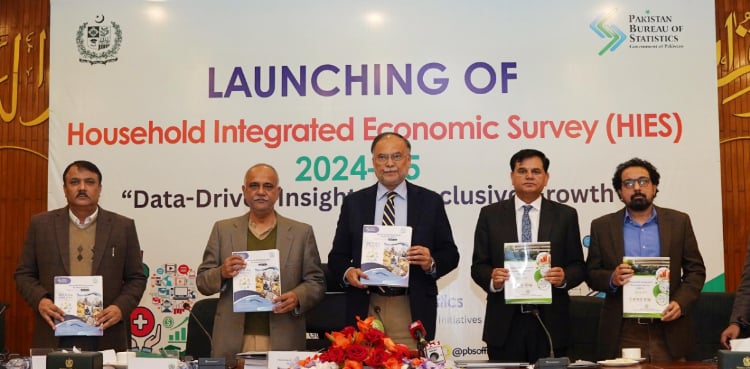
ISLAMABAD: Pakistan has launched the results of its latest Household Integrated Economic Survey (HIES) 2024–25, with the government describing it as a key step towards data-driven policymaking and economic recovery.
The survey was unveiled on 1 January 2026 by the Federal Minister for Planning, Development and Special Initiatives, Ahsan Iqbal, at a ceremony in Islamabad.
The event was hosted by the Chief Statistician, Dr. Naeem uz Zafar (SI), Muhammad Sarwar Gondal (SI), Member (SS/RM) ,Ms. Rabia Awan DDG (PSLM/PCS), and was attended by key stakeholders, members of the Technical Committee, and senior officers from the Ministry of Planning and the Pakistan Bureau of Statistics (PBS).
PBS has completed and released the results of the HIES 2024–25, marking a major milestone in Pakistan’s national data ecosystem. Endorsed by the Technical Committee, the survey provides comprehensive insights to review the social and economic conditions of the country and serves as a key tool for evidence-based planning and policymaking.
According to PBS, the HIES 2024–25 is the country’s first fully digital household survey, conducted after the Digital Population and Housing Census of 2023. It covered 32,000 households nationwide and was completed through quarterly field operations by June 2025, using an integrated digital management and monitoring system.
The survey shows significant improvements in digital access. Household ownership of mobile phones or smartphones has risen to 96 percent, while internet access at the household level has increased from 34 percent to 70 percent. The proportion of individuals using the internet has more than tripled, reaching 57 percent.
Education and health indicators also show gradual improvement. Gender parity at the primary school level has increased from 92 to 96 percent, while neonatal mortality has fallen from 41 to 35 deaths per 1,000 live births. Infant mortality declined from 60 to 47 per 1,000 live births, and the total fertility rate decreased slightly from 3.7 to 3.6 children per woman.
The use of cleaner fuels including natural gas, LPG, biogas, solar energy and electricity rose to 38 percent of households.
On the economic front, PBS reported increases in household income and consumption. Food accounts for the largest share of household spending at 37 percent, followed by housing and fuel at 26%. Other major expenses restaurants and hotels 6.63%, clothing and footwear 6.28% and transport 6.21% at national level.
Addressing at the event, the Minister stated that the Ministry of Planning and PBS have successfully been transformed into modern, data-driven institutions, which is a highly encouraging development. He noted that the Planning Ministry is systematically clearing long-standing institutional backlogs and strengthening its analytical capacity.
Ahsan Iqbal highlighted that Pakistan’s first-ever digital population census was a major national achievement, followed by the Digital Agriculture Census and the Economic Survey of Pakistan, all of which were conducted successfully.
He argued that weak planning in recent years, combined with global shocks such as the Covid-19 pandemic, had slowed economic growth and disproportionately affected the middle class.
However, he said the country was now on a path to recovery, expressing confidence that Pakistan could achieve around 4 percent GDP growth in the current fiscal year.
Ahsan Iqbal stressed the need to tackle what he described as an “education emergency”, noting that around 25 million children remain out of school. He said near-universal literacy was essential for long-term development and called for political stability and policy continuity to sustain progress.
At the conclusion of event, PBS highlighted that HIES 2024–25 reflects significant progress in education, health, digital access and household income.