
Germany's VW to roll out self-driving electric minibus in Oslo
- By DPA Service -
- Dec 10, 2025


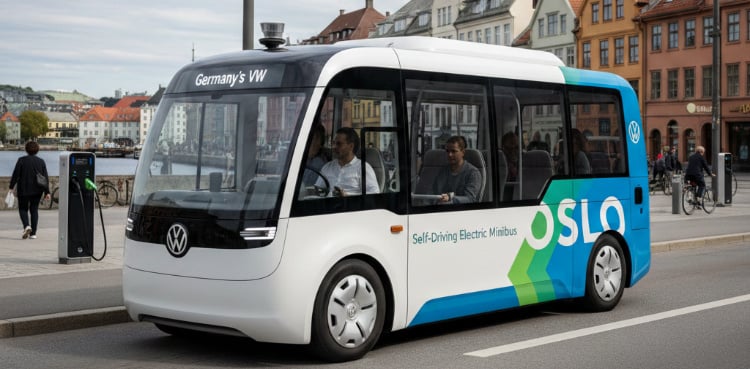
German manufacturer Volkswagen has signed a deal to roll out its self-driving minibus in Norway.
A partnership agreement has been reached with Oslo transport operator Ruter and Nordic operator Holo, Volkswagen subsidiary Moia said on Wednesday.
From early 2026, VW will provide the electric ID. Buzz vehicles and booking software, including an app.
Oslo is the third city in Europe after Hamburg and Berlin where Moia is launching the self-driving ID. Buzz AD. Los Angeles in the United States is expected to follow next year, where Moia is cooperating with the Uber ride-hailing service.
So far, the vehicles are still driving with a mandatory safety driver behind the wheel who can intervene if necessary. According to earlier statements, VW aims to obtain approval for driverless operation in Europe and the US by the end of 2026.
After that, the safety driver will no longer be necessary. Test drives with prototypes have been under way since 2021.
Germany to register 693,000 fully electric cars in 2026
Conversely, Germany is expected to register around 693,000 new battery electric vehicles (BEVs) next year, the German Association of the Automotive Industry (VDA) confirmed.
This would represent an increase of roughly 30% compared with projected 2025 figures.
Including other alternative drivetrains such as plug-in hybrids, the VDA expects nearly 1 million new registrations of vehicles with electrically assisted powertrains.
Registrations of new plug-in hybrids are expected to fall slightly, by about 5% to 286,000 vehicles.
The forecast for fully electric cars is slightly below that of the Association of International Motor Vehicle Manufacturers, which anticipates around 740,000 new BEVs next year – assuming the government’s planned incentives for private EV buyers come into effect. The VDA said the same condition applies to its own estimates.
For the overall market, the VDA expects only a modest recovery. Total new passenger car registrations across all powertrain types are projected at 2.9 million next year, a rise of about 2% from 2025.