
Abdullah Shafique’s 160 vs West Indies: A Masterclass That Ended Pakistan’s 49-Year Caribbean Drought
- By Khurram Shahzad -
- Aug 05, 2026


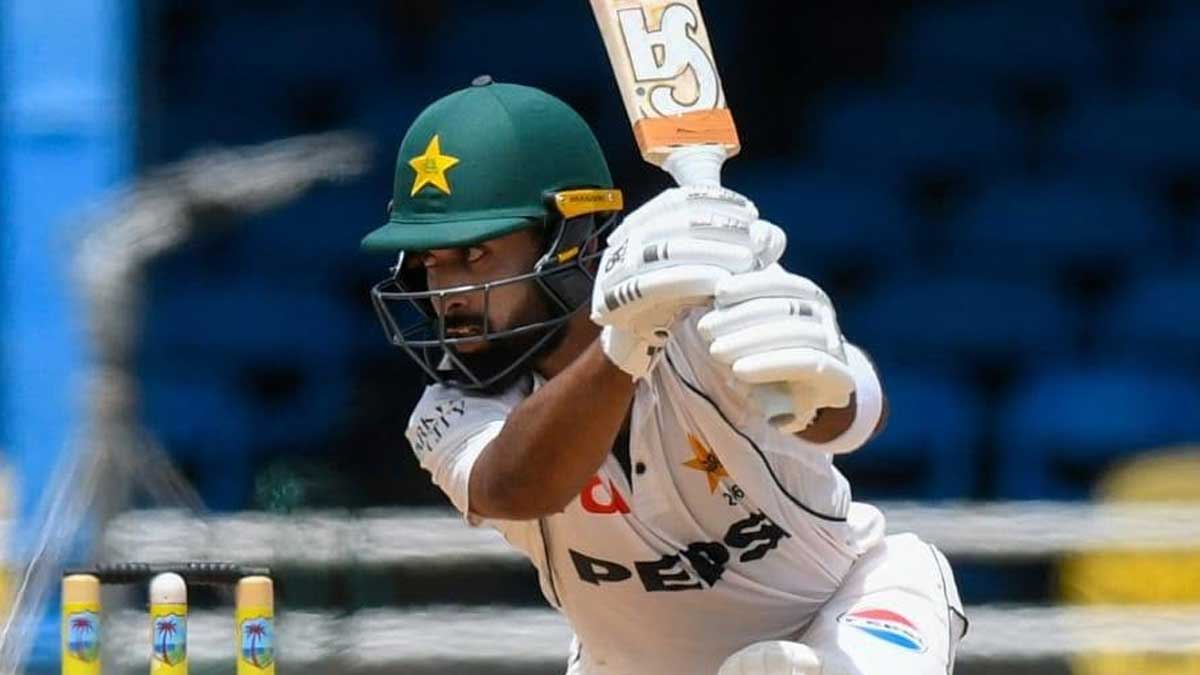
Under the hot, humid conditions of Queen’s Park Oval, Port of Spain, Abdullah Shafique delivered a batting performance arguably the biggest for a Pakistani batter in the Caribbean for almost five decades. His unbeaten 160 off 323 balls during the second Test against West Indies in August 2026 wasn’t just a personal milestone; it was an assertion of grit, technique and character.
Drafted into the team as a cover for Shan Masood’s finger injury (and with adjustments required due to Abdullah Fazal’s unavailability), the 26-year-old right-hander assumed the No. 3 position for the first time in his nascent Test career. Generally an opener, Shafique walked into bat following the early departure of Imam-ul-Haq and quickly settled his team into the innings. A 64-run association with Azan Awais (55) was followed by a formidable 183-run partnership with captain Babar Azam (88, run out) and when Pakistan were eventually all out for 387 – gaining a narrow 43-run advantage over West Indies’ first-innings 344 – Shafique remained unbeaten, having absorbed the bulk of the bowling with composure and aplomb.
Numbers do not lie and the ones on Shafique’s scorecard tell a tale of resilience and calculated attacking: fifteen boundaries and three sixes, a strike rate nudging 49.5, and an innings stretching across one and a half days. He reached his sixth Test century, and the first since 2024, with a characteristic pull off Jomel Warrican. He roared in relief after a tough phase during which he had failed to register 20 in 25 of his last 35 Test knocks. However, his conversion rate from 45 has always been exceptional and this innings was a testament to that.
The innings was a technical masterclass against both the pacemen and the spinners on a surface that gradually offered turn. Early on against the new ball, and later against the returning Kemar Roach, Shafique’s classical drives through midwicket and down the ground raced to his fifty. Against the left-arm spinner, Jomel Warrican (who finished with 6 for 112), Shafique employed textbook footwork, sweeping when the ball was on middle stump, and then adjusting his feet to lift the off-side of the ball over the infield with two towering sixes when Warrican offered the required width. He displayed the art of selectivity, letting the good balls go through to the keeper and punishing the loose ones without undue haste, soaking up pressure after the first-Test reverse by 90 runs.
The knock is historically significant as it made Abdullah Shafique only the fifth Pakistan batter to score 150 or more runs in a Test innings in the Caribbean. The illustrious list includes Hanif Mohammad (337 in 1958), Wazir Mohammad (189 in 1958), Majid Khan (167 in Guyana in 1977), and Saeed Ahmed (150 in 1958). He is the first Pakistan player to achieve this feat since Majid Khan-and the first ever by a batter batting at No. 3 for the Green Shirts on Caribbean soil. His 160* dwarfed Saeed Ahmed’s 68-year-old mark for the highest individual score by a Pakistani batter in the No. 3 spot on West Indies’ shores.
Abdullah Shafique has 6 centuries in Tests, the most by any Pakistan batter since his debut in 2021. In this period, he also has most sixes (23) for Pakistan and is the only batter with four innings of 300+ balls. You simply can’t leave this Kitaabi player out of the team!
— Mazher Arshad (@MazherArshad) August 4, 2026
In the limited-overs format against the Windies, his records have been largely underwhelming: 55 runs in three ODIs in 2025 at an average of 18.33. In contrast, this knocks represents by far his most memorable batting contribution against the Caribbean nation, and it came after a spell wherein his career, which had threatened to catapult him into the stratosphere of rapidly achieving Test milestones, had appeared to stall relative to expectations. However, it only confirmed the very high potential that pundits and coaches had consistently recognised in the elegant strokes and innate talent of the right-hander.
The knock had a galvanising effect on Pakistan’s chances, enabling his spinners to rip through West Indies and leave them 103/6 at close of play on day three, with the home side having only a slender lead of 60 and just four wickets in hand. Such is the nature of a two-Test series, the knock not only provided redemption for the 90-run opening defeat but put Pakistan back in the driving seat to win the series and gain important World Test Championship points. From a coaching perspective, this innings showcased selective aggression.
Asad Shafique, a former Pakistani batsman who has coached several players, singled out Abdullah Shafique’s ability to put away the bad ball while leaving the good ones, identifying those very attributes as hallmarks of success in alien conditions.
Moreover, a player who had come up through the ranks as an opener to seamlessly adapt and carry his bat throughout an entire team innings proved his adaptability under immense pressure. Abdullah Shafique’s 160* against West Indies will forever be etched in cricket annals, not just for the run accumulation or the record books, but for the impeccable execution and the story of its creation – resilient, unruffled, and authoritative. In an era where Pakistan’s top order has often been questioned for its consistency, the innings was a timely affirmation of the inherent quality that had marked Shafique as a player for the future; and even now, the past will always serve as an example of what the future can bring, especially after a batting performance of such calibre abroad.