
Black hole erupts for the third time as scientists watch in real time
- By Kumail Shah -
- Jul 22, 2026


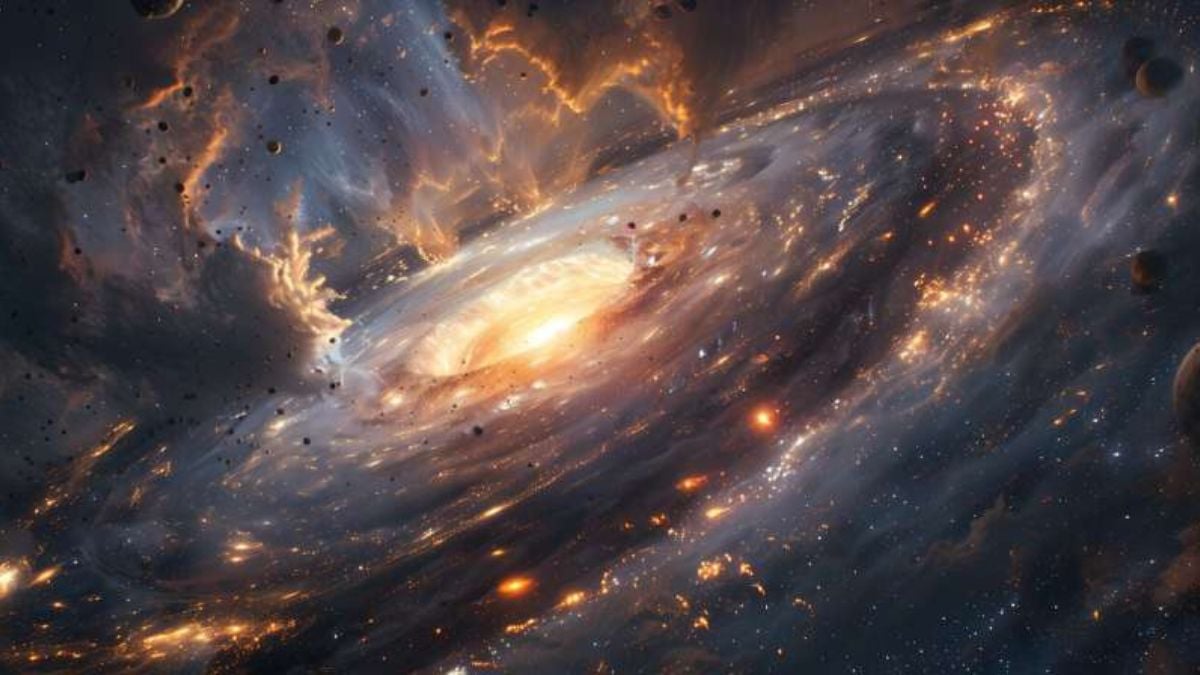
A massive black hole at the heart of the IC 3599 galaxy has erupted for the third time in 35 years, but for the first time, scientists were able to observe the event as it unfolded.
The black hole, which sits about 280 million light-years from Earth, last erupted in 1990 and again in 2010. In both cases, astronomers only realized what had happened after the flares had already faded from view.
This most recent eruption marks the first time researchers have witnessed such a dramatic cosmic event from start to finish.
In October 2025, astronomers noticed the galaxy had suddenly become 50 times brighter than usual. Led by D. Grupe of Northern Kentucky University, a team quickly turned both space-based and ground-based telescopes toward the black hole to study the flare in detail.
They discovered the black hole, which weighs about two million times the mass of our Sun, had reached its maximum theoretical brightness limit. Interestingly, its X-ray light continuously flickered in a repeating pattern every 7.4 hours.
READ MORE: Taurus dark cloud reveals tiny gas drift that could kick-start star birth
Telescopes also detected glowing signatures of energized iron, indicating that the eruption was heating gas well beyond the black hole’s immediate area.
Because the eruptions happen repeatedly, scientists have heavily debated the exact cause. The gaps between the massive outbursts are notably irregular at 19.5 years, then 15.7 years, which makes it highly unlikely that an orbiting star is repeatedly crashing into it on a perfectly fixed schedule.
Instead, researchers point to a natural instability in the disk of gas around the black hole as the likely trigger. In this scenario, the black hole’s intense light pushes against the gas, causing it to build up in an unstable way.
Eventually, the gas reaches a breaking point and violently collapses inward, causing a massive flash. The area then empties, cools down, and slowly refills to start the cycle all over again.
Although alternative theories still exist, like a decaying star being slowly stripped of its energy or two massive black holes orbiting each other, this gas collapse theory fits the new data best.
The new findings, published on July 10, offer astronomers a rare and valuable view of the extreme physics at play in distant galaxies.