
China rescuers search for missing after mine blast kills 82
- By AFP -
- May 24, 2026


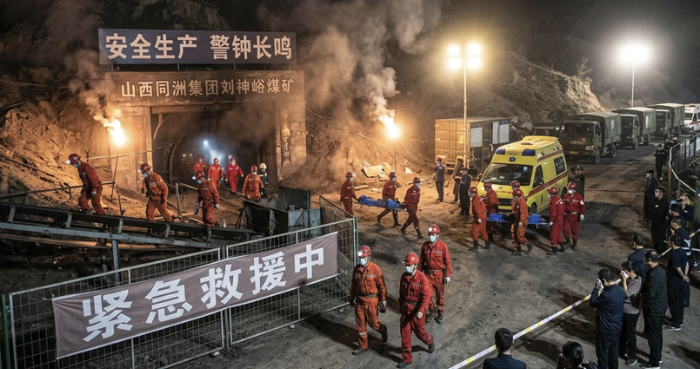
Emergency rescuers in northern China were undertaking a major operation on Sunday to find two people still missing after a gas explosion at a coal mine killed at least 82.
The blast at the Liushenyu shaft in Shanxi province on Friday was the country’s worst mining disaster in nearly two decades, with 247 workers underground at the time, according to state media.
Hundreds of rescuers have rushed to the site, with medical teams taking 128 people to hospital as of Saturday evening, loaded into ambulances and carried on stretchers.
AFP journalists saw police blocking the road leading to the mine late Saturday, allowing only authorised vehicles to enter.
Helmeted rescuers took turns descending into the shaft overnight to look for the two missing workers, also sending down a robot to probe the mine conditions, state media reported.
“As long as there is hope, we will make every possible effort,” one rescuer told state news agency Xinhua.
Mining violations
Chinese authorities launched an investigation into the blast, the worst since 2009 when 108 people were killed in a mine explosion in northeastern Heilongjiang province.
Preliminary findings showed the company operating the mine, reported as Shanxi Tongzhou Group, had committed “serious illegal violations”, authorities told a press conference broadcast by the state-run CCTV.
“Those found responsible will be severely punished in accordance with laws and regulations,” they added.
More than half of the workers in the shaft on Friday had gone down without being properly registered, state media said, citing a personnel board at the site.
The miners are normally required to undergo facial recognition checks or take location-tracking cards before their descents.
A person “responsible for” the company had been “placed under control in accordance with the law”, Xinhua said.
The State Council, China’s cabinet, ordered nationwide “tough crackdowns on illegal and unlawful activities”, including the falsification of safety data, unclear headcounts of underground workers and illegal contracting.
Sulphur smell
Wounded survivor Wang Yong told CCTV he heard no sound but smelled sulphur when the explosion happened.
“I didn’t hear any sound at all, but then a cloud of smoke appeared,” the miner said.
“It (had) the smell of sulphur like when people set off firecrackers. When the smoke came down, I shouted for people to run.”
He recalled seeing people choked by the smoke before he fainted.
“After more than an hour, I came to on my own, and then I woke up the person next to me” and got out, he told CCTV.
Foreign leaders extended condolences to the victims and their families, with Japanese Prime Minister Sanae Takaichi saying she was “praying for the rescue of as many people as possible”.
India’s Narendra Modi expressed hope that “the bereaved families find strength in this tragic hour”.
Taiwan’s President Lai Ching-te said the self-ruled island — claimed by Beijing — “stands ready to provide humanitarian assistance”.
Shanxi, one of China’s poorer provinces, is the centre of the country’s coal-mining industry.
Mine safety in China has improved in recent decades, but accidents still occur in an industry where safety protocols are often lax and regulations vague.
In 2023, a collapse at an open-pit coal mine in the northern Inner Mongolia region killed 53 people.
China is the world’s top consumer of coal and the largest greenhouse gas emitter, despite installing renewable energy capacity at record speed.