
Currency Rates in Pakistan Today - Dollar, Saudi Riyal and UAE Dirham
- By Anjum Wahab -
- Jul 06, 2026


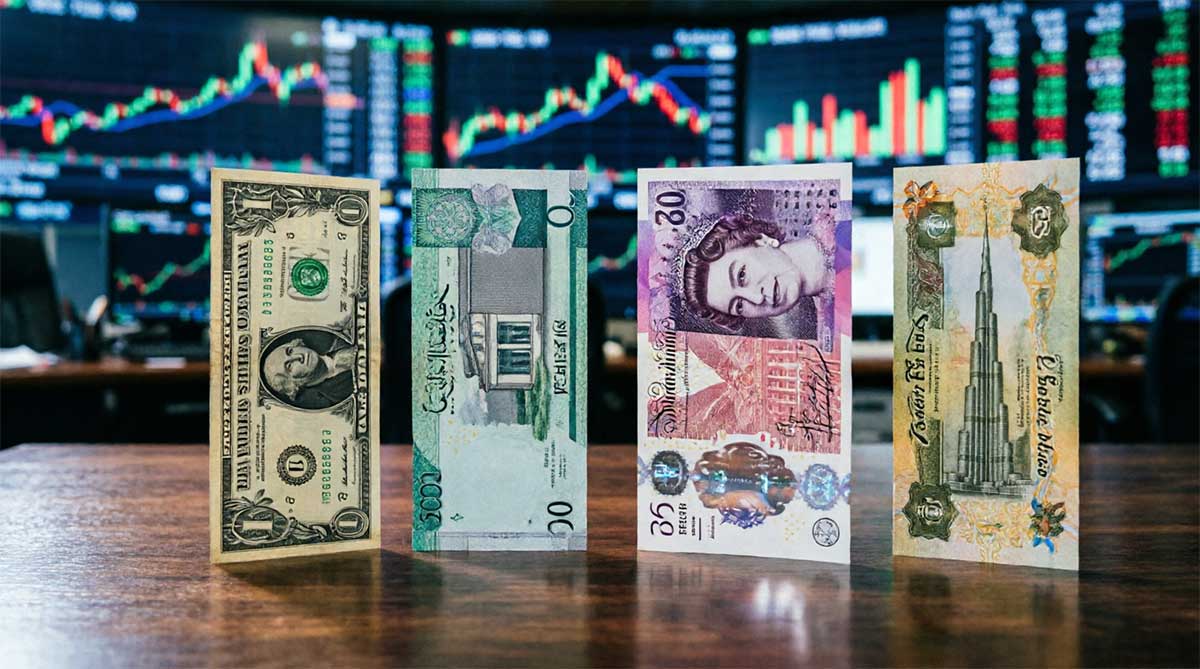
KARACHI: State Bank of Pakistan’s Mark-to-Market Currency Rates for Monday provide a somewhat muted picture, showing a slight softening of the rupee against the dollar compared to the end of June.
The US dollar quoted at 278.1131 in the ready market, slightly down from 278.2022 on 24 June – a decline of approximately nine paisas or about 0.03 percent. The Saudi Riyal eased to 74.0647 from 74.1220, the UAE Dirham to 75.7182 from 75.7487 and the Canadian Dollar to 195.5582 from 195.5108. The Bahraini Dinar and Omani Riyal also followed suit, declining to 738.7200 and 722.3810, respectively.
While the move is too small to suggest any decisive shift, its direction is noteworthy. After staying flat through most of June, the rupee now seems to be slowly slipping. The one-month dollar forward is at 281.4585, implying market expectations for a spot rate weakening by about 1.2 percent in the next 30 days. The one-year forward at 292.5813 translates into an annual depreciation of about 5.2 percent from the current level – neither alarming nor trivial, but steady.
The Gulf currencies have behaved as expected, mirroring the dollar’s movements as they are pegged to it. The Saudi Riyal’s decline of nine paisas against the dollar aligns perfectly, and the UAE Dirham’s three-paisa dip tracks this movement closely. This is a mechanical effect.
When the dollar strengthens against the rupee, its Gulf peers, pegged at their fixed rates, do the same.
This means a worker sending 1,000 Riyals home today will receive about 74,065 rupees, a reduction of about 57 rupees from 24 June. The difference, though small, impacts purchasing power over time.
The Canadian Dollar, however, has moved in the opposite direction to some extent. At 195.5582, it represents a rise of roughly five paisas compared to 24 June, meaning the rupee has appreciated a bit against the loonie. The six-month forward at 203.0314 and the one-year at 209.1265 suggest a stronger pace of Canadian Dollar deprecation against the rupee than the dollar against the rupee, potentially reflecting factors like anticipated weakness in the Canadian economy or increased Pakistani demand for Canadian products.
Across all these currencies, the forward curves show a uniform pattern: a gradual depreciation in the short term, steepening moderately at the one-year mark. The three-month dollar forward at 282.6336, the six-month at 286.3149 and the nine-month at 289.7136 form a smooth upward slope that points to market expectations of a steady, gradual slide rather than any sudden shock. This contrasts sharply with the steep forward premia seen during periods of severe financial stress, when the curve would sharply kink at the front end.
For businesses, this stability in short-dated forwards offers a measure of predictability in their hedging costs. A company that needs to cover its dollar payables for delivery next month can lock in the rate at roughly 281.46, a premium of about 1.2 percent, which is manageable for most. Similarly, exporters face no urgent need to liquidate their foreign exchange earnings, as the immediate future is not seen as precipitous for the rupee.
The rates for the Bahraini Dinar and Omani Riyal, while less impactful on daily life for the average Pakistani, remain significant for trade and labour flows between Pakistan and these countries. The Dinar at 738.72 and the Omani Riyal at 722.38 follow the dollar peg dynamic of the Saudi and UAE currencies, with their higher spot rates stemming from stronger pegged values to the US dollar.