
Currency Rates in Pakistan Today - USD, GBP, SAR and AED
- By Anjum Wahab -
- Jul 10, 2026


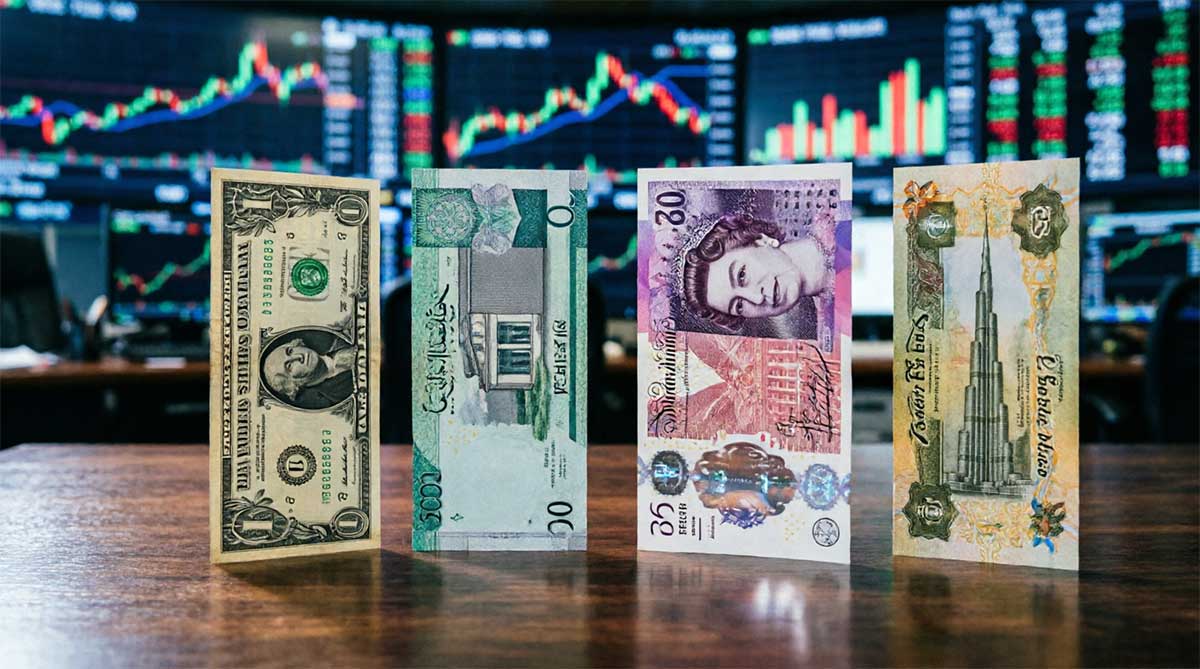
KARACHI: The State Bank of Pakistan’s 10 July 2026 currency rates report shows that the Pakistani Rupee (PKR) gave up ground against US dollar as the dollar (USD) settled at 278.0540 in the ready market, down from 278.0633 on 9 July — a loss of roughly nine paisas for the rupee.
The Saudi Riyal (SAR) weakened to 74.0648 PKR from 74.0554, while UAE Dirham (AED) firmed slightly to 75.7104 PKR from 75.7129. The Canadian Dollar (CAD) climbed to 196.2619 PKR from 196.0539, adding about 21 paisas.
The British Pound (GBP) stood at 372.9539 PKR in the ready market, the highest among the tracked currencies and a level that reflects the pound’s persistent strength against emerging market currencies. The Bahraini Dinar and Omani Riyal both moved against the rupee, with the Dinar at 737.4657 PKR and the Omani Riyal at 722.1808 PKR.
One month dollar forward 279.7573, showing an expectation of about 61 paisas in depreciation during the month to come. Three months forward at 282.3806 and six months at 285.9473 exhibit the same mild slope up trend that has characterized the market over the week, while one year forward at 292.4104 predicts an annual rate of depreciation of about 5.2 percent at the prevailing spot price.
The changes in Riyal and Dirham matter so little that a remitting family in Punjab, Khyber Pakhtunkhwa and Azad Kashmir wouldn’t bother following it. A remittance worker sending home a 1,000 Riyals receives about Rs.74,065 at this moment, or about 10 rupees more than on 9 July, while 1,000 Dirhams fetch around Rs.75,710, about a difference of 3 rupees.
The Turkish Lira stands at 5.9179 PKR in the ready market offers a point of comparison for two economies often grouped together by investors. Turkey and Pakistan share vulnerabilities — high inflation, large current account deficits, reliance on external financing — yet the lira trades at a fraction of the dollar’s rupee value because of Turkey’s much larger money supply and different monetary framework.
The Indian Rupee (INR) at 2.9143 PKR in the ready market tells another story. Pakistan and India do not trade directly, but the rupee-rupee cross is watched closely as a proxy for relative economic health. India’s larger foreign exchange reserves, deeper capital markets, and stronger manufacturing base have allowed the Indian rupee to hold steadier against the dollar than its Pakistani counterpart.
The Chinese Yuan (CNY) at 41.0209 PKR in the ready market carries weight for a different reason. China is Pakistan’s largest trading partner and the source of the bulk of its machinery, electronics, and consumer goods imports. The yuan’s stability against the dollar — and by extension against the rupee — has helped contain import costs even as the Pakistani currency faces broader pressure.