
Dacia Hipster: Europe’s Tiny EV Challenger to Chinese Minis
- By Reuters -
- Oct 06, 2025


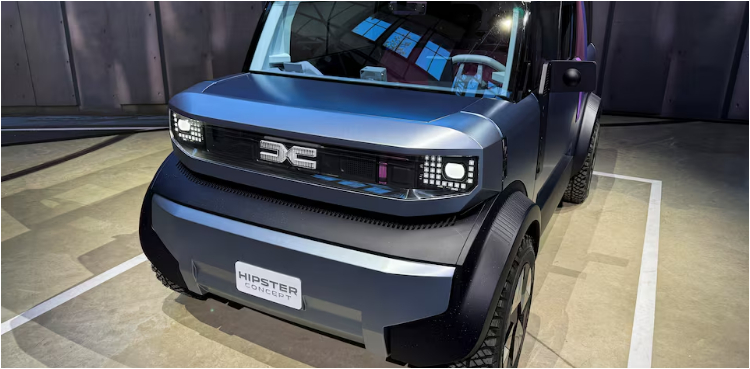
Renault’s low-cost brand Dacia on Monday unveiled a prototype electric mini-car that could cost less than 15,000 euros (Rs.4956353), potentially providing a competitive alternative to low-cost Chinese electric vehicles.
The “Hipster Concept”, which could go into production if the European Union agrees to create a new small car category, is tiny, only 3 metres (9.84 ft) long and weighing less than 800 kg (1,763.7 lb). The shortest car on the market in Europe today, Leapmotor’s, T03 city car, is 62 cm longer.
The Hipster is “a concept of Dacia’s bold vision for local, affordable and everyday mobility,” said Dacia’s CEO Katrin Adt, who recently moved from Mercedes-Benz. “If the opportunity to mass produce it arises, we are ready.”
Dacia’s Hipster Specification
The boxy three-door Hipster’s room for four adults inside, and its boot can swallow up to 500 litres. It’s 20 per cent lighter than Dacia’s all-electric tiddler. The maximum speed would be around 90 km per hour (55.92 mph) and it would have a range of 150 km.
According to data from Dacia, the average car travels under 40 km daily at an average speed of 56 km per hour.
Dacia Hipster offers enough range for daily journeys and hypothetically would only need to be recharged twice a week, there’s no word on the Hipster’s battery pack
The tail-gate extends across the entire rear end, and opens in two parts to reveal a huge aperture for easy loading and unloading. The rear lights are located behind the tailgate glass so they don’t need a separate panel or recess. One body colour is available, and there are only three painted parts. It’s almost a flat-pack car.
Dacia admits that the Hipster is basically a block on four wheels. Dacia’s design chief, David Durand, said the aim was not to mimic larger vehicles: “We didn’t want to do something small that’s pretending to be another car. A cube can look tough and robust. We were also inspired by Japan’s kei cars.
It looks like you’re well protected. It has a high beltline, and the driving position is same as it is in the Sandero. The Hipster is small and friendly looking.
The Hipster’s features a high beltline and Sandero-like driving position for safety. Its body uses Starkle, a material made from 20 percent recycled plastic sourced from old bumpers and dashboards, giving it a speckled appearance that Dacia chose to embrace rather than hide.
Dacia Hipster’s Interior:
Dacia has also simplified the Hipster to slash costs: it has canvas seats, a bare minimum of electronics, manual windows and straps to open the doors instead of handles. The interior colour is limited to the grey-blue of the prototype. Safety is kept basic, with driver and passenger airbags.
The head-rests are minimal. There’s an airbag for the driver and passenger. Dacia also integrates its YouClip accessories system with 11 anchor points for extras such as cupholders, armrests, and storage boxes.
Instead of a built-in infotainment system, the Hipster includes a smartphone docking station connected to a portable Bluetooth speaker, with the phone doubling as a digital key.
Durand emphasized that the Hipster takes inspiration not from the iconic Mini itself but from its philosophy: “The Mini made people think differently in its era by maximizing interior space within a small frame. That’s the spirit we wanted to recreate.”