
DG ISPR doubts KP government’s ‘willingness’ to counter terrorism
- By Hamid Ur Rehman -
- Nov 29, 2025


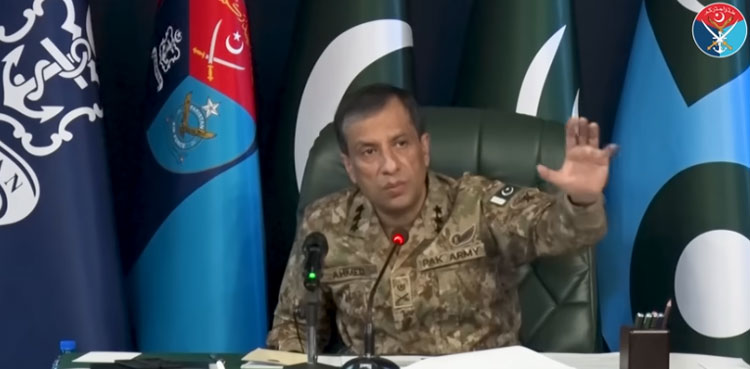
RAWALPINDI: Director General Inter-Services Public Relations (ISPR), Lieutenant General Ahmed Sharif Chaudhry, has expressed “serious concerns” regarding the Khyber Pakhtunkhwa (KP) government’s efforts in combating terrorism, ARY News reported on Saturday.
Lt Gen Ahmed Sharif Chaudhry shared these remarks during a meeting with senior journalists where he discussed national security, ongoing counterterrorism operations, border management, and regional challenges—particularly those relating to Afghanistan.
Providing an overview of recent operations, the DG ISPR said that 4,910 intelligence-based operations (IBOs) had been conducted since November 4, averaging 233 operations per day.
“The intensity of the kinetic counter-terrorism effort is increasing,” he said, adding that 206 terrorists have been killed in these operations.
Sharing figures since January, Lt Gen Chaudhry said 67,023 IBOs had been carried out across the country including over 53,000 IBOs in Balochistan, 12,000 in Khyber Pakhtunkhwa and approximately 850 IBOs in other areas of the country.
He noted that Pakistan has witnessed 4,729 terrorist incidents this year, including 3,357 in KP, 1,346 in Balochistan, and 26 in other regions.
Border management
The DG ISPR addressed the growing “narrative” questioning how terrorists cross the Pakistan-Afghanistan border despite the heavy deployment of Frontier Corps and Army personnel.
He highlighted the challenges posed by the porous, rugged mountainous terrain and snow-covered border fences.
He further explained that a border fence has limited value without continuous observation and fire coverage, adding that it takes only five minutes to breach a fence in the absence of such security. “Even the United States has not been able to hermetically seal its border with Mexico,” he noted.
The DG ISPR said the border area is home to dozens of tribes, making movement control extremely difficult.
He said that the Afghan Taliban border posts first engage Pakistan Army posts with fire to facilitate terrorist infiltration.
Lt Gen Chaudhry highlighted the absence of governance in certain high-risk regions, stating that in some areas, including Tirah Valley, only 5–10% administration presence exists.
“You will not find any administration in specifically terrorists prone areas”, he said. “There are no courts or government departments enforcing the state’s writ”.
The DG ISPR reiterated that both internal administrative gaps and external cross-border challenges continue to complicate Pakistan’s counterterrorism landscape.
“One is administrative issues in the hinterland, and then on the border you have populations across on both sides”, DG ISPR said.
He added that Fitnah Al-Khawarij (FAK) networks support terror and crime cells operating inside Pakistan.
Where is the administration? Who is responsible?
The military spokesperson said that highly coordinated attacks are being carried out on Pakistan Army and Frontier Corps (FC) check posts along the border to facilitate the passage of smugglers’ vehicles.
He questioned the lack of internal control beyond the border areas, asking: “If terrorist groups and smugglers manage to cross the border, then who is responsible for the hinterland? Is that also the Army’s responsibility?”
“Where is the administration over there?” he added, highlighting governance gaps.
The DG ISPR further questioned the provincial government’s oversight regarding illegal vehicles: “If there are 4.5 lacs non-custom-paid vehicles moving in your province, why are they not being stopped? Who is responsible for checking them? Why is no action being taken? Whose responsibility is this?”
He said these non-custom-paid vehicles form a crucial part of the political-terror-crime nexus, and are frequently used in car bombings and terrorist movement within the province.
What is missing in Khyber Pakhtunkhwa
Telling the details of the non-kinetic counterterrorism efforts in Balochistan, Lt Gen Chaudhry said that following a crackdown, Iranian diesel smuggling had decreased by 210%, dropping from 20.5 million litres per day to 2.7 million litres per day.
He added that 27 out of 36 Category B areas had been brought under police jurisdiction, covering 86% of the province’s population.
The DG ISPR also highlighted various development initiatives—such as the installation of tube wells, fishing and agriculture projects, water schemes, and dams—calling them key components of the non-kinetic points of the National Action Plan (NAP).
He said that combined engagement by the Balochistan provincial and district administrations, along with security forces, included 140 activities per day, such as school visits and sports initiatives.
“This is a gradual, long-term effort being carried out in Balochistan, and it has far-reaching consequences. This is the real solution to terrorism—one that provincial and district governments must lead,” he noted.
The DG ISPR remarked, “We feel all of this is missing in Khyber Pakhtunkhwa.”
He added that while Balochistan also faces India-sponsored terrorism, the provincial government is at least actively combating it, and its “willingness is visible.”