
Dinosaur egg found in perfect condition after 70M years
- By Kumail Shah -
- Oct 25, 2025


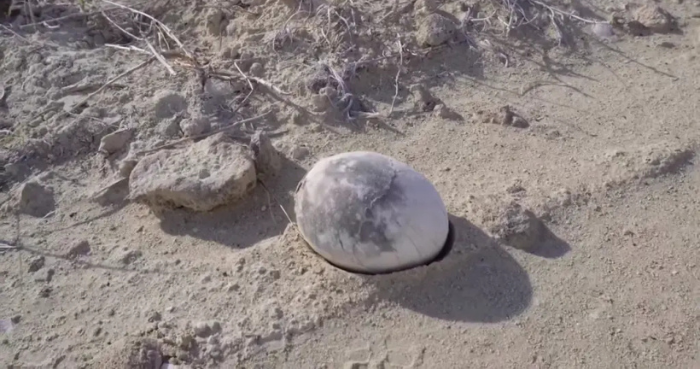
Argentine paleontologists have discovered a real gem in the terrain after happening upon a perfectly preserved 70-million-year-old dinosaur egg during an excavation campaign in the fossil-rich region of Río Negro.
“It was a complete and utter surprise,” Gonzalo Leonel Muñoz, a vertebrate paleontologist at the Bernardo Rivadavia Argentine Museum of Natural Sciences, told National Geographic. He described the “spectacular” discovery, noting that while dinosaur fossils are not uncommon, finding eggs is much rarer.
Dinosaur eggs had been excavated in the area before, but finding one this well-preserved was super rare, as they stumbled across the primeval embryo.
Accompanying footage and photos were posted to the Laboratory of Comparative Anatomy and Vertebrate Evolution’s Instagram page showing team leader and world-class anatomist Federico Agnolín holding the egg, which is in such perfect condition that it looks hard-boiled.
“This is quite possibly the FIRST finding of this type in South America,” read the caption to one of the clips. “As you can see, this fossil is over 70,000,000 years old, and IT WASN’T ALONE, WE FOUND A NEST.”
This egg, roughly the size of an ostrich embryo, likely came from a small, carnivorous theropod called Bonapartenykus, which lived in this area during the Late Cretaceous period.
Muñoz stated that finding the egg of a possible carnivorous dinosaur, especially in such a state, was unusual. He also noted that they were accustomed to seeing sauropod dinosaur eggs (those with long necks), but these had spherical eggs, like enormous balls, with thicker shells.
The scientist observed that finding the eggs of carnivorous dinosaurs was rare, as there were far fewer meat-eaters, and their eggs were much more fragile, given that they were the ancestors of birds.
As the discovered eggs were from ancestors of birds, the scientist observed that finding the eggs of carnivorous dinosaurs was rare, as there were far fewer meat-eaters and their eggs were much more fragile.
“Their eggs are more avian-like, since the carnivorous dinosaur lineage is the one that will give rise to birds,” the paleontologist described. “Therefore, they’re going to be more delicate eggs, with much thinner shells, more prone to destruction.”
He mentioned that the egg, along with other findings from the repository, will be sent to the Argentine Museum of Natural Sciences to be examined.
It is still unclear whether the fossilized shell holds an embryo; the team will have to conduct deep scans to find out.
Muñoz expects the egg may have something inside, as this would confirm what species of dinosaur it is and potentially shed light on dinosaur evolution.
He added that if the dinosaur was carnivorous, it could teach them about the evolution of dinosaur eggs into birds. It could reveal what their chicks were like, their state at birth, and whether they were fully developed. He concluded that any information it provided would be novel and incredibly interesting.