
Field Marshal Asim Munir meets Iranian President, discusses regional peace
- By Laiq Ur Rehman -
- Jun 23, 2026


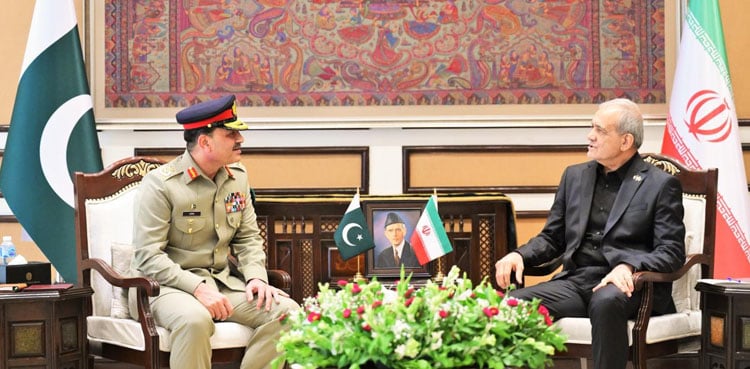
RAWALPINDI: Field Marshal Syed Asim Munir met the President of the Islamic Republic of Iran Dr Masoud Pezeshkian, in a high-level interaction focused on regional developments and promotion of peace, the Inter-Services Public Relations said in a statement issued on Tuesday.
According to the military media wing, Field Marshal Syed Asim Munir, NI (M), HJ, COAS & CDF, called on the President of the Islamic Republic of Iran, Dr. Masoud Pezeshkian, during which views on regional developments and peace initiatives were exchanged.
The Iranian President appreciated Pakistan’s constructive and responsible role in promoting dialogue, de-escalation, and regional stability. He acknowledged Pakistan’s consistent efforts to encourage peaceful resolution of disputes and foster understanding among regional stakeholders at a time of heightened geopolitical challenges.
Field Marshal Syed Asim Munir reiterated Pakistan’s unwavering commitment to peace and stability in the region.
Both sides reaffirmed their commitment to further strengthening Pakistan-Iran relations and maintaining close consultations on issues of mutual interest, with the shared objective of advancing peace, prosperity and stability across the region.
Earlier, Iranian President Dr Masoud Pezeshkian arrived in Pakistan for a state visit on the invitation of Prime Minister Shehbaz Sharif.
A high-level delegation, including ministers and other high-ranking officials accompanied Dr Masoud Pezeshkian.
Pezeshkian was welcomed at the PAF Base Nur Khan by President Asif Ali Zardari, Prime Minister Shehbaz Sharif and Deputy Prime Minister and Foreign Minister Mohammad Ishaq Dar.
This is Dr Masoud Pezeshkian’s second visit to Pakistan in his capacity as President of Iran.
During the visit, the two sides will review the full spectrum of bilateral relations and explore new avenues to further deepen cooperation across diverse sectors, including trade, energy, border security, people-to-people exchanges, and regional connectivity.