
Field Marshal, Lebanese army chief discuss defence collaboration amid regional tensions
- By Laiq Ur Rehman -
- Jun 09, 2026


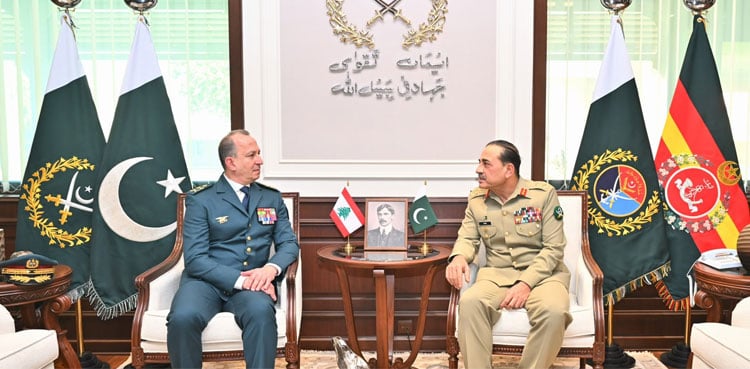
RAWALPINDI: General Rodolphe Haykal, Commander-in-Chief of the Lebanese Armed Forces, called on Field Marshal Syed Asim Munir, Chief of Army Staff (COAS) and Chief of Defence Staff (CDF), at General Headquarters (GHQ) in Rawalpindi, the Inter-Services Public Relations (ISPR) said on Tuesday.
Upon his arrival at GHQ, the visiting dignitary was presented a Guard of Honour by a smartly turned-out tri-services contingent.
According to the military’s media wing, the two military leaders exchanged views on matters of mutual interest, the evolving regional security environment, defence cooperation, and prospects for enhancing bilateral military relations.
The discussions focused on strengthening professional interactions, expanding training cooperation, and enhancing institutional linkages between the armed forces of both countries.
Field Marshal Syed Asim Munir reaffirmed the importance Pakistan attaches to its longstanding and cordial relations with Lebanon and underscored Pakistan Army’s commitment to expanding defence collaboration with the Lebanese Armed Forces.
General Rodolphe Haykal appreciated the professionalism and operational excellence of the Pakistan Armed Forces and acknowledged their contributions to regional peace, stability and international peacekeeping efforts.
The visit reflects the shared commitment of both armed forces to fostering closer military-to-military cooperation, the ISPR added.
Read More: Oil falls as Lebanon and Israel agree to implement ceasefire
The visit comes amid heightened regional tensions and ongoing diplomatic efforts to stabilize the Middle East.
A new U.S.-mediated ceasefire agreement between Israel and Lebanon raised hopes for progress toward ending the wider U.S.-Israeli war with Iran, though there was still uncertainty about how and when it would be implemented.
Tehran has made a ceasefire in Lebanon a condition for any peace deal with Washington, and has suggested in recent days that it could intervene directly in support of its proxy Hezbollah if Israel keeps up or escalates attacks there.