
Grammarly rebrands as 'Superhuman' after acquisition
- By Kumail Shah -
- Oct 30, 2025


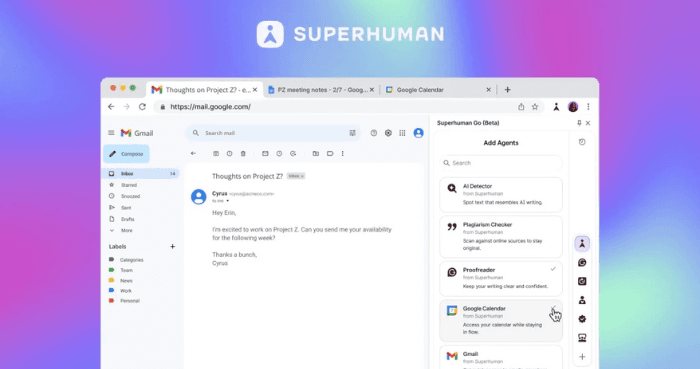
Writing assistant tool Grammarly is rebranding itself as Superhuman. The branding change came after the acquisition of the email client Superhuman in July.
While core Grammarly products will continue to function as they were, the company plans to eventually rebrand its other acquired products, such as the productivity platform Coda, in the long run.
The company is also launching an AI assistant called Superhuman Go, an AI assistant integrated into Grammarly’s existing extension. This new assistant offers writing suggestions and email feedback. It can also be connected with applications such as Jira, Gmail, Google Drive, and Google Calendar to enhance its contextual understanding. These connections enable it to perform tasks like logging tickets or retrieving your availability for meeting scheduling.
Superhuman stated it plans to add functionality to allow the assistant to fetch data from sources like Customer Relationship Management (CRM) and internal systems to recommend changes to your emails.
Users can try Superhuman Go by turning on a toggle in the Grammarly extension (preferably Chrome), which allows them to integrate it into other apps. Users can also utilize other agents from the company’s agent store, which includes a plagiarism checker and a proofreader, launched in August.
Superhuman Go is available to all Grammarly users. The company also offers product bundles: the Pro plan costs $12/month (billed annually) for multi-language grammar and tone support, while the Business plan costs $33/month (billed annually) and includes Superhuman Mail (the acquired email client).
Superhuman also aims to add more AI-powered features to the Coda document suite and Superhuman email clients, such as pulling details from external and internal sources to automatically create more details in documents and email drafts.
Grammarly has intensified its focus on becoming a comprehensive productivity suite in recent years, as demonstrated by its acquisitions of Coda and Superhuman. By introducing this new AI assistant, the company aims to enhance its competitive standing against rivals such as Notion, ClickUp, and Google Workspace, all of which have introduced numerous AI features.