
What Hazem Mohamed's American Tour Says About Egypt — and the Gap Pakistan Karate Federation Still Has to Close
- By DJ Kamal Mustafa -
- Jul 23, 2026


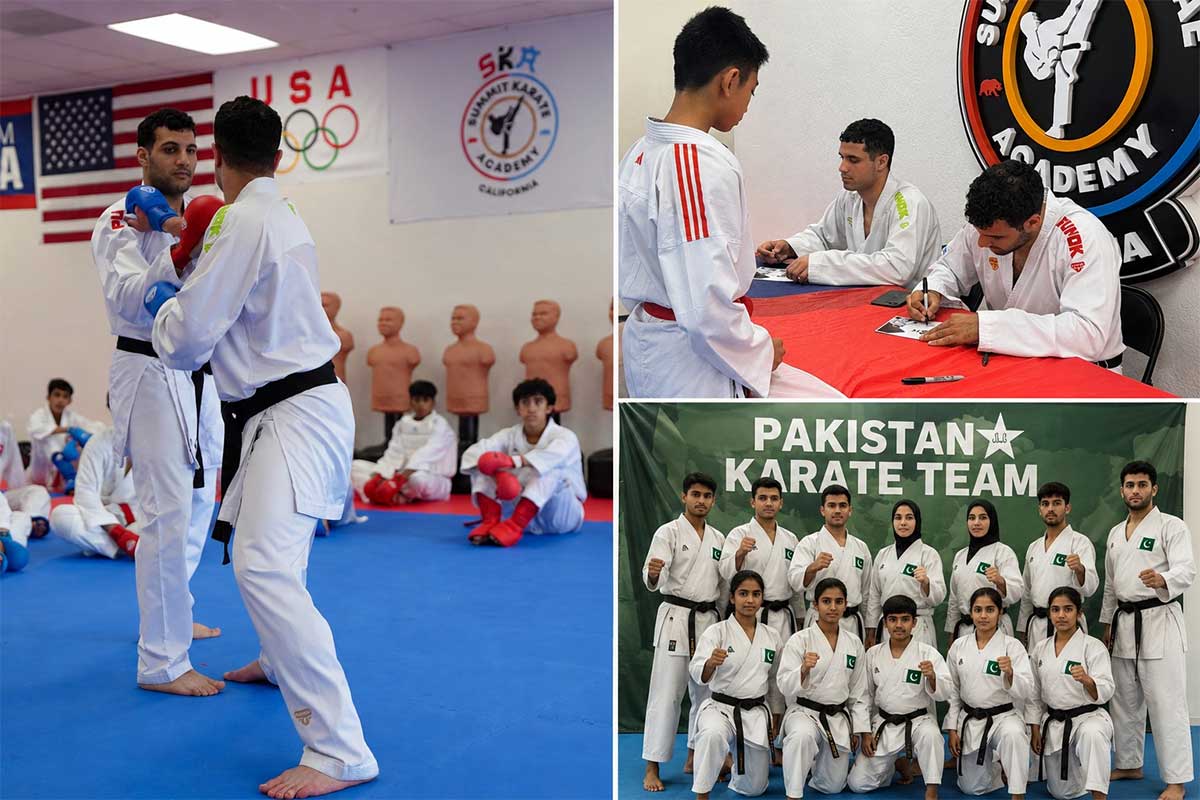
Egyptian karate has not always commanded attention on the world stage. For decades the sport existed in the shadow of football, quietly building talent in neighborhood clubs while international federations paid little notice. That began changing over the last decade, as a handful of Egyptian fighters climbed world rankings once dominated by Japan, France and the traditional European powers, countries that have spent generations building national training infrastructure Egypt simply never had access to. A recent training tour across the United States is worth reading against that backdrop rather than as an isolated event.
The tour ran through two camps in June: a shorter stop at Stoney Brook Karate in Winter Garden, Florida, on June 20 and 21, drawing roughly 100 athletes, and a longer one at Summit Karate Academy in Sunnyvale, California, from June 24 to 30, drawing close to 150 — pulling in athletes and coaches from Canada, Mexico, Venezuela, Brazil and Colombia along the way. What made it notable was not the headcount but who chose to attend in person. Three coaches from the U.S. national program sat in on sessions in Sunnyvale: John Limcaco, head coach of the R1 US Team and IKF Team; Toni Mendonca, head coach of Mendonca Academy; and Joanne Orbon, head coach of the UBAKC Team. They came to watch a fighter with a 2019 world title won in Chile, five African championships, and five Karate1 Premier League medals behind him. That imbalance is worth sitting with for a moment. Programs with far greater resources do not typically look to smaller federations for instruction, they usually export their own methods outward. When the flow runs the other way, it is rarely about budget and almost always about something harder to buy, which is a training approach that consistently produces results under pressure.
That is the more interesting story than the medal count itself. Hazem Mohamed’s own path is fairly ordinary by elite sport standards: he started at age four at Nadi Shobra El-Nahas, worked through Al-Siyouf Club, and has trained at Smouha Club since 2012, with two loan seasons at Al Ahly Bank Club in 2024 and 2025. What is less ordinary is how consistently he has moved from competitor to instructor without the usual gap between the two roles. Most retired champions struggle to teach precisely because the instincts that win fights are difficult to translate into language, they know what works but not always why, and a season or two removed from competition often blunts the specificity of what they can pass on. Hazem Mohamed is teaching while still actively competing, which means the material he brings to a camp has not had time to go stale into generic principle. Coaches abroad are not just meeting a champion, they are meeting someone translating this year’s competitive experience into method in close to real time. In Sunnyvale, they were meeting two: Mohamed shared instructional duties across both camps with Youssef Badawy, another active Egyptian world champion, so the room had two current world-level competitors teaching rather than one veteran name lending credibility to a program built by others.
Even so, the granular substance of what was taught is still thinner than the résumé behind it. The Florida sessions are described as focused on kumite development, technical refinement and tactical application; the California sessions as built around transferring high-level competitive experience to a larger, more international room. That’s closer to a program description than an account of method. We still don’t know, for instance, whether what draws coaches from five countries is a particular tactical sequencing, a way of training under simulated pressure, or something less exportable like the sheer volume of elite competition Mohamed has absorbed firsthand. It’s also fair to ask whether some of this interest is simply proximity to a rising ranking rather than genuine method, since international sport has no shortage of coaches chasing whoever is winning this year. What argues against pure ranking-chasing is that this wasn’t a one-off: Mohamed ran a comparable seminar at Ipswich Karate Academy in England back in November 2025, months before this particular wave of attention. A coach showing up once might be chasing a moment; a pattern of camps across continents, months apart, is closer to something else. Still, a pattern isn’t proof, and the distinction matters, because one produces a passing trend and the other produces lasting influence.
Set next to this, Pakistan’s own karate program looks like it is standing still. The honors list the Pakistan Karate Federation (PKF) itself points to on the Pakistan Olympic Association’s site tops out at regional competition: a haul at the 1999 South Asian Federation Games in Kathmandu, a stronger showing at the 2004 edition in Islamabad, medals at the 2006 South Asian Games in Colombo, and a smaller tally in Dhaka in 2011. A Commonwealth Championship gold from 2009 is the closest thing to an outlier. What doesn’t appear anywhere in that record is a Karate1 Premier League medal, a WKF world ranking anyone abroad would recognize, or a world championship title of the kind Hazem Mohamed won in Chile in 2019. At the 2025 Islamic Solidarity Games in Riyadh, Pakistan’s karate contingent fielded five athletes across men’s and women’s divisions as part of a national team that finished 24th overall on the medal table — competitive enough to send a squad, nowhere near the level where international coaches fly in to learn from it.
That gap is not really about talent. Pakistan has produced individual fighters with real ability; what it hasn’t built is the pipeline Egypt has, where a national program keeps producing world-level competitors closely enough together that active champions can double as instructors abroad while still fighting. Pakistani sport more broadly has spent the past two years under public scrutiny over exactly this kind of infrastructure question — the Pakistan Sports Board has been pushing federations toward a model constitution, stricter election rules and a code of governance specifically because of concerns about transparency and accountability in how national federations are run and funded, a push several federations have resisted as a threat to their autonomy. Karate has not been singled out the way some other federations have, but it also hasn’t been exempted from the broader pattern: a national body with a constitution, an Olympic-committee affiliation and a stated mission almost identical to Egypt’s, without the sustained international results, marquee training exchanges, or visible funding pipeline that would let it produce a Hazem Mohamed-type figure of its own.
What Egypt’s example actually offers Pakistan is not a shortcut but a template. Egypt did not arrive at Sunnyvale by accident: it took years of exposing its fighters to Karate1 Premier League stops (including hosting one, in Cairo, in 2025), continental championships, and enough international mat time that a competitor like Mohamed could accumulate a world title, five African titles and five Premier League medals before turning any of it into a teaching career. If the PKF wants a fighter capable of drawing foreign coaches to a Pakistani-run camp rather than sending Pakistani coaches to observe everyone else, the target is not a single gifted athlete but a system that keeps producing them — consistent Premier League entries rather than occasional appearances, a defined path from club karate to the senior national team, and active competitors given the platform to coach while still fighting, the way Mohamed and Badawy did in Sunnyvale together.
None of that happens without the Pakistan Karate Federation first doing the unglamorous work Egypt’s program has already done. It needs a transparent, verifiable funding and selection process that the Pakistan Sports Board’s own governance push is already asking every federation to adopt, rather than resisting it as outside interference. It needs to budget for regular entries into WKF-ranked events — Karate1 Premier League and Series A, continental championships — instead of treating international competition as an occasional trip, since ranking points and world-level experience are what eventually make a fighter worth flying coaches in to see. And it needs to identify its own strongest active competitors now and give them a defined role in coaching younger athletes while they are still fighting, rather than waiting for retirement to convert a champion into an instructor. Egypt’s tour through Florida and California didn’t happen because one fighter got lucky; it happened because a federation spent a decade making sure a fighter like that would eventually exist. That is the part Pakistan Karate Federation still has to build.
Disclaimer: The views expressed here are solely the author’s and do not necessarily reflect the opinions and beliefs of ARYNews or its management.