
IHC full court meeting approves Practice and Procedure rules with majority of votes: Sources
- By Hussain Ahmed Chaudhry -
- Sep 03, 2025


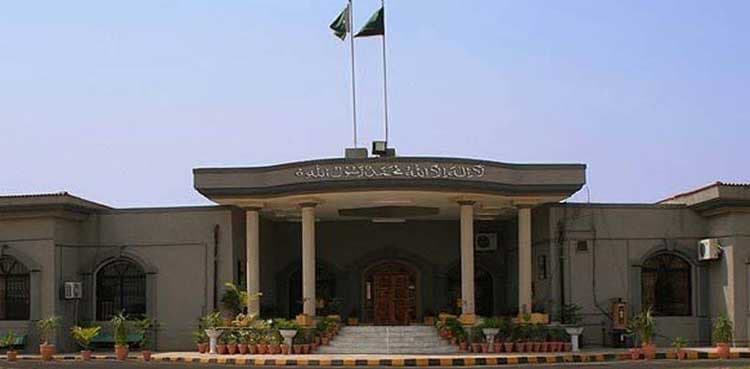
ISLAMABAD: The important decisions of the full court meeting of Islamabad High Court (IHC) have surfaced as the practice and procedure and establishment rules were approved with a majority of votes, sources said, ARY News reported.
Sources said that the practice and procedure and establishment rules were approved without any discussion. Whereas the practice and procedure and establishment rules 5 and 6 were approved with a majority of votes.
Chief Justice Sarfaraz Dogar, Justice Arbab Muhammad Tahir and Justice Khadim Hussain Soomro, Justice Azam Khan, Justice Muhammad Asif and Justice Inam Ameen Minhas voted in favour of the rules.
On the other hand, Justice Mohsin Akhtar Kiyani, Justice Tariq Jahangiri, Justice Baber Sattar, Justice Sardar Aijaz Ishaq Khan and Justice Suman Riffat Imtiaz opposed the rules, sources added.
Sources said that the amendments demanded by two judges in a letter for the agenda of the full court meeting have been rejected. The insistence by another judge for the postponement of the full court meeting was also rejected.
The opposing judges have demanded the postponement of the approval of the practice and procedures and establishment rules, the sources said. However, CJ IHC Sarfaraz Dogar rejected the demand.
The meeting has taken a consensus decision on an agenda item regarding the powers of judges in the family court, the sources said.
While the first two agenda items were approved with a majority of votes, sources said. The first agenda item regarding the powers of the judges in the family court was approved with a majority of votes.
Similarly, the meeting also approved an agenda regarding the problems of the IHC building with a majority of votes.
Moreover, the meeting approved that the building problems of the IHC will be sent to the federal government, the sources added.
Earlier, IHC Chief Justice Dogar chaired a full court meeting attended by all judges of the high court.
The meeting’s agenda included service rules, practice and procedure rules, powers of family judges, and issues related to the IHC building’s construction.
Before the holding of today’s meeting, the two judges of the Islamabad High Court (IHC) — Justice Babar Sattar and Justice Sardar Ejaz Ishaq Khan — wrote letters to Chief Justice Sardar Muhammad Sarfraz Dogar, raising concerns over transparency and judicial independence.
The Chief Justice Islamabad High Court (IHC) Justice Sarfraz Ahmed Dogar has summoned full court meeting at 2:00 pm today to mark the start of new judicial year. All IHC judges have been issued instructions to attend the meeting.
In his letter, Justice Babar Sattar urged the inclusion of key issues in the meeting’s agenda, questioning whether the IHC was fulfilling its constitutional duty to safeguard fundamental rights against the abuse of power by the state.
He criticised the practice of excluding senior judges, including the senior puisne judge, from heading divisional benches, terming the fixation of cases under CJ Dogar contrary to institutional norms.
He also expressed concern over the IHC’s diminishing role in protecting citizens’ rights and described the district judiciary as a “game of musical chairs” dominated by deputationists rather than an independent institution.
“Should the Islamabad District judiciary continue to look like a game of musical chairs played predominantly by deputationists or does IHC have the responsibility to develop district judiciary as an independent institution possessed of integrity and efficiency?”, he said. “Should fixation of cases rest on the whims of the CJ or should there be transparency in who hears what case, while matching the expertise of judges to the work they are asked to do?.
Justice Sattar further stated that judges are not kings and their administrative powers are neither unfettered nor should be exercised in a colorable manner.
Justice Sardar Ejaz Ishaq Khan, in his letter, criticised the late circulation of the new Islamabad High Court Practice and Procedure Rules (PPR), saying judges had been given only a day and a half to review the “voluminous” document.
“I take strong exception to the PPR being shared with the Judges only a day-and-a-half before the meeting, as if we were possessed with some magical powers to read, analyze, and comment usefully on such a voluminous treatise that will regulate the functioning of the IHC and its subordinate Judiciary”, he said.
Justice Sardar Ejaz Ishaq Khan termed the exercise “devoid of meaningful discussion” and objected to being excluded from its drafting.
“It seems the full court meeting will only be a formality, or in any event, devoid of any meaningful discussion on the PPR. I therefore bring it to your notice that I am unable to give any meaningful input on the PPR for being excluded during the process of their conception and drafting.
He recommended some issues to include in the agenda of the Full Court meeting.
The reconstitution of the Administration Committee without the inclusion of the Senior Puisne Judge and the senior-most Judges.
2. The requirement of NOC for the Judges’ travel abroad.
3. The transfer of pending cases from one Judge to another by an inappropriate invocation of the adage that the CJ is the master of the roster.
4. The ever-eroding independence of the Islamabad High Court and the complicit role of a clique of IHC Judges in this erosion.
Read More: IHC’s new bench on Dr Aafia Siddiqui case dissolved
Justice Khan described the NOC condition for foreign travel as a “blatant impingement” of judges’ fundamental right of movement and a below-the-belt strike on the independence of the Judiciary, equating it to placing judges on a de facto Exit Control List (ECL). He said such instructions struck “a mighty blow” to judicial independence.
“What does it matter to CJ whether a Judge spends his vacations in Pakistan or abroad?” he added.