
India extends export incentive scheme “RoDTEP” until March 2026
- By Reuters -
- Sep 30, 2025


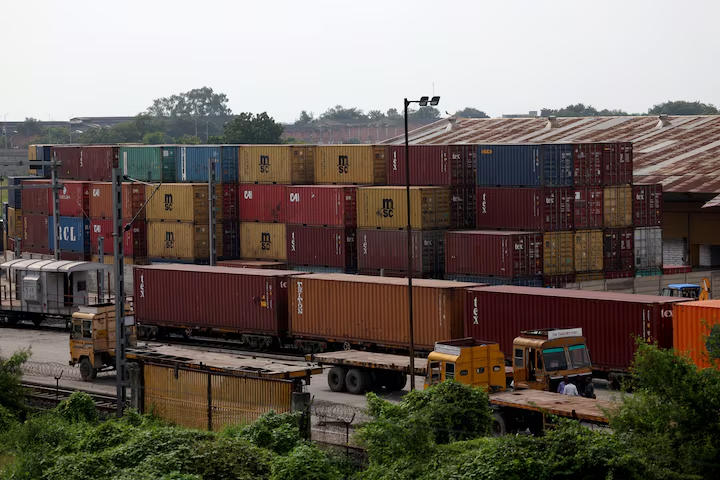
The Indian government said on Tuesday that it would extend its flagship export incentive scheme, the Remission of Duties and Taxes on Export Products (RoDTEP) of India, until March 2026, according to a commerce ministry notification.
The scheme reimburses exporters for taxes, duties, and levies at the central, state, and local levels that are not refunded under any other programme but are incurred during the manufacture and distribution of export products.
The scheme was due to end on September 30.
The extension follows calls from exporters for financial support after U.S. President Donald Trump raised tariffs on Indian goods, doubling levies to as much as 50%, hitting shipments of textiles, leather goods and food products.
Currently, RoDTEP covers more than 10,000 products, ranging from agriculture and textiles to engineering goods, offering incentives worth 1%-4% of product value in lieu of taxes paid by exporters.
Read Also: India to build first cross-border railway with Bhutan
In other news, India and Bhutan will build the first cross-border railway lines connecting both countries, New Delhi announced Monday, with the $454-million project to be completed in four years.
Indian foreign secretary Vikram Misri said his country, which is Bhutan’s main trading partner, “has played a vital role” in the modernisation of the Himalayan kingdom’s infrastructure and economy.
The rail project will be of “huge benefit to the people of Bhutan,” India’s Minister of Railways Ashwini Vaishnaw said.
“The entire area will get connected. And lots of goods movement, which takes days today, will start happening in few hours.”
An initial 69-kilometre (43-mile) railway, estimated to cost 34.56 billion rupees ($390 million), will connect India’s northeastern city of Kokrajhar to Bhutan’s Gelephu, a town of 10,000 people near the Indian border.
A second 20-kilometre railway line, expected to cost 5.77 billion rupees, will link Bhutan’s northwestern industrial centre of Samtse to Banarhat in eastern India.
Tiny and landlocked, with a population of less than 800,000, Bhutan is wedged between China and India and is known for its policy of prioritising “Gross National Happiness” over growth.
But it hopes to develop Gelephu as an economic zone to attract foreign investment and tourists, with the new railway key to its development.
“It is envisaged as an economic hub connecting Bhutan with South Asia and Southeast Asia,” Misri said.