
Madyan Hydropower Project’s future uncertain as WB withdraws funding
- By Fawad Ali -
- Jun 27, 2026


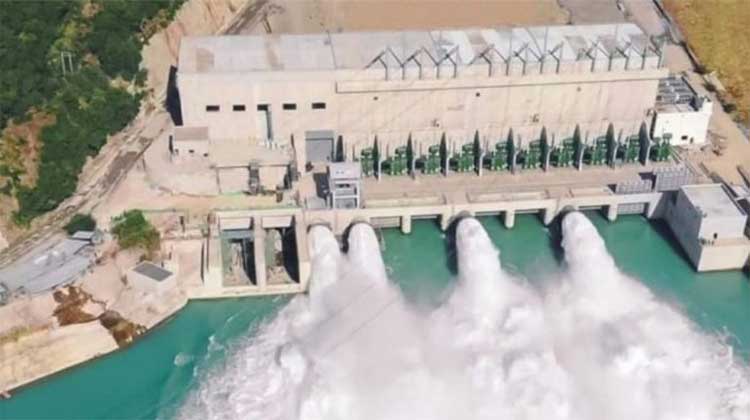
Inamullah, 60, stood on a bridge over the Daral River, a tributary of the River Swat that flows through the Bahrain Bazaar, a scenic valley in the Swat district of Khyber Pakhtunkhwa, northwestern province of Pakistan. Facing the dry, sewage-streaked bed of the Daral River and with the roaring River Swat behind him, he recalled a time when the river flowed with such force that tiny droplets would rise from below and splash onto the faces of those standing on the bridge. “The river in front of me was diverted into tunnels for a hydropower project,” he said, turning toward the River Swat behind him. “Now this one is planned to meet the same fate.” The river was diverted for the 36.6-megawatt Daral River project by the provincial government of Khyber Pakhtunkhwa (hereafter, Pakhtunkhwa)
However, the Pakhtunkhwa Energy Development Organization (PEDO) planned the 207-megawatt Madyan Hydropower Project (MHPP). This time, as he claims, the plan is to divert the River Swat into tunnels.
The project, he said, is one of at least 18 schemes planned between the Kalam and Madyan valleys in the district, part of the World Bank-funded Khyber Pakhtunkhwa Hydropower and Renewable Energy Development projects, approved in 2021 for a total of USD 450 million.
Under the MHPP, water from the River Swat will be diverted near Kalam through a tunnel carved into the mountain. A powerhouse will be constructed downstream near the Utror area. From Utror onward, the river will once again be diverted into a tunnel running through the mountains and brought out near the Kedam area, where another powerhouse will be established. Then, from the Dan Ramit area near Kedam, the river will be diverted into yet another tunnel and released near Kalagay village, close to Madyan valley, where a third powerhouse will be constructed.
The community has not forgotten the losses caused by the Daral River project. So, when plans surfaced to divert the River Swat, they started fierce resistance and launched the “Save River Swat” movement in 2023. With earlier promises, which include building a modern health facility, school, and part of the revenue generated from the hydropower project on the development of the valley before the Daral River project, still unmet, many fear another ecological and cultural disaster in the shape of diverting the River Swat. “If the previous project damaged the ecology and tourism, diverting the River Swat would push the already marginalized Torwali community toward obscurity,” said Zubair Torwali, a researcher and leading voice of the movement. The community has already been coping with the recurring climate disasters. Zubair Torwali said that the development projects, wrapped in promises of progress, would deliver another blow to their livelihoods, culture, and ancestral landscape of the Torwali community, whose language UNESCO has already declared severely threatened.
The hydropower projects act as a double-edged sword for the local environment, people, and economy, leading to eight destructive displacement risks for indigenous populations: landlessness, joblessness, homelessness, marginalization, food insecurity, increased morbidity, lost access to common resources, and community dislodgment.
Arguing about the impacts of the hydropower project, Zubair said that displacement from such projects would occur in two ways. “First, people living in the project area, who get compensated no doubt, would be physically forced to leave their homes and land, becoming displaced people. Second, those downstream would not relocate but lose access to rivers that sustain their livelihoods,” he argued. He added that displacement is not just about losing a house or land; it would cause a deeper resettlement effect, in which people would lose livelihoods, community networks, cultural identity, and social and religious ties. The community believes the project could negatively affect tourism, a major source of income for residents, as the River Swat is a key element of the valley’s scenic beauty and a key attraction for visitors. Moreover, what angered the community was the overlooking of Torwali’s identity in the PEDO’s Resettlement Action Plan. The plan, deliberately or mistakenly, reduced the valley to a Yousafzai-majority landscape, flattening a far more complex cultural reality. Whether through oversight or design, the effect remains the same: a mountain community rendered invisible in plans that seek to reshape their river, land, and future.
The hydropower projects act as a double-edged sword for the local environment, people, and economy, leading to eight destructive displacement risks for indigenous populations: landlessness, joblessness, homelessness, marginalization, food insecurity, increased morbidity, lost access to common resources, and community dislodgment.
Malik Dil Nawaz, 55, a Torwali elder, claimed that what was flowing downstream in the river is what local ecology needed, adding that once the river was diverted into tunnels, the entire ecological balance would be disrupted. “Tourism, farming, and fishing, all dependent on the river, along with the way of life of the Torwali community, which is shaped by the river for centuries, will gradually fade.
The other side of the story
Following the consistent protest of the community, the World Bank (WB) eventually withdrew its financial support for the project, officials at PEDO said. Following WB withdrawal, the provincial cabinet in April 2026 delinked the MHP from its WB-funded projects.
Senior PEDO official[s], familiar with the development, dismissed the community’s concerns as fear-based and unnecessary. “With the World Bank’s withdrawal, the project will no longer benefit from the institution’s independent oversight and rigorous environmental and social safeguards,” the PEDO official feared. “The Bank’s financing came with strict compliance requirements and mechanisms to address environmental and social safeguards. Whether the same standards can be maintained under provincial financing remains uncertain,” the official doubted.
Citing a precedent, another PEDO official said the same community in 2010-11 had resisted the then Daral River hydropower project. “Their protest led the Asian Development Bank (ADB) to withdraw its funds from financing the scheme,” he said, adding that the community now invokes as justification for opposing the Madyan Hydropower Project.
He added that under the ADB-backed proposal for the DRHP, PEDO had been obligated to release 0.7 cubic meters per second of water downstream, plant 10 trees for every tree felled. In addition, PEDO had to establish a state-of-the-art hospital equipped with modern facilities for the local population, alongside other social development initiatives.
After the ADB withdrew its funds, the provincial government arranged alternative financing and revised the downstream water flow requirement from 0.7 to 0.2 cumecs.
“If the government secures alternative funding for the MHP, there is a risk that similar environmental and social commitments, originally tied to the World Bank-funded plan, may also be revised,” the official feared.
While responding to the community’s concerns, another official at PEDO, familiar with the initial designing of the MHP, said that hydrological data collected between 1962 and 2022 showed average water flows during the peak summer months of May, June, and July at 5,650 cusecs, 10,735 cusecs, and 11,000 cusecs, respectively.
“The downstream flow would remain at an average of 850 cusecs in May, 5,297 cusecs in June, and 5,650 cusecs in July after diversion, which, according to ecologists and environmental experts, was more than enough to sustain downstream needs required for ecological balance,” the official explained. He added that the 12-kilometer area where the diversion would take place is largely uninhabited, dismissing the community’s claims that the riverbed would run dry as a result of the project.
The official maintained that, under World Bank–mandated environmental safeguards, PEDO was obligated to plant 10 trees for every tree removed during construction. He added that the project also included the construction of five bridges linking the previously disconnected and relatively unexplored left bank of the valley to the National Highway, a development expected to improve regional accessibility and promote tourism in the area. As many as 4.9 million tourists, including 5237 foreigners, visited the Swat district in 2025, according to the Pakhtunkhwa Cultural and Tourism Authority.
In addition, according to the project document, three large public parks and green areas totaling approximately 300 kanals (151757 m²) were planned under the WB-funded initiative.
“The hydropower project, if implemented, is expected to generate PKR17 billion annually and create more than 800 employment opportunities for the residents during the construction phase.”
The PEDO officials said that equipping the local health centers with modern equipment, establishing computer laboratories in schools, and providing vocational training in gemstone extraction, cutting, and polishing for residents of the affected villages were part of the WB-funded initiative. PEDO officials feared that many of the welfare schemes promised under the World Bank-funded project might not be implemented if the Khyber Pakhtunkhwa government finances the project from its own resources
Conditional consensus
The provincial government has decided to finance the project through the Indicative Generation Capacity Expansion Plan (IGCEP), Pakistan’s 10-year strategic roadmap for the power sector. PEDO officials claimed that the World Bank remained willing to fund the project, provided the local community withdrew its resistance. On the other hand, the community maintains that it is open to PEDO’s demands if the project is redesigned, particularly by abandoning the proposed river diversion. “What the community demands is to construct a dam, which is not our mandate,” the officials say. “Any disruption in flow downstream will disrupt our way of life in the area we have inhabited for centuries,” Nawaz fears.#
Note: None of the officials was willing to speak on the record as they were officially barred by the provincial government from speaking on the issue.
Disclaimer: The views expressed here are solely the author’s and do not necessarily reflect the opinions and beliefs of ARYNews or its management.