
From Galwan to Sindoor: How Modi's Policies Failed India
- By DJ Kamal Mustafa -
- Jun 12, 2026


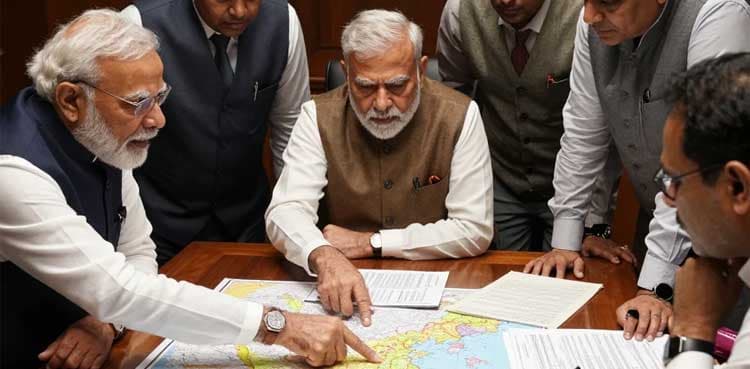
As Modi becomes India’s longest-serving elected Prime Minister, his foreign policy record demands a reckoning.
When Narendra Modi surpassed Jawaharlal Nehru’s record on June 10, 2026 — completing 4,399 consecutive days as India’s elected Prime Minister — the celebrations inside the Bharatiya Janata Party were predictably thunderous. International congratulations arrived from Rome, Canberra, and Kuala Lumpur. The optics, as always under this government, were immaculate. The substance, as twelve years of evidence now confirms, is another matter entirely.
The most instructive place to begin is not with Operation Sindoor but with the Galwan Valley on the night of June 15, 2020. More than twenty Indian soldiers were killed in hand-to-hand combat with Chinese forces — the first military casualties on the Line of Actual Control in forty-five years. More than seventy were injured; nearly a hundred, including officers, were reportedly taken captive. Modi’s response was to tell the nation that ‘nobody has intruded into our border, neither is anybody there now, nor have our posts been captured.’ Satellite imagery and retired army generals said otherwise. Congress President Sonia Gandhi asked pointedly: if no incursion had occurred, how did more than twenty soldiers lose their lives?
This pattern reappeared in May 2025. When India launched Operation Sindoor following the April 22 Pahalgam terror attack (to remember it was an Inside job & Internal failure) that killed 26 civilians, the government’s narrative was one of unqualified triumph. The reality emerged slowly, through admissions by India’s own officials. The Chief of Defence Staff acknowledged losses of multiple fighter jets in the initial stages at a seminar in Singapore. India’s naval defence attache in Jakarta was blunter: ‘We did lose some aircraft, and that happened only because of the constraint given by the political leadership not to attack the military establishment.’ The US-China Economic and Security Review Commission’s 2025 Annual Report independently confirmed multiple jet losses —information that was withheld from Parliament and the public for weeks. Demands for a Special Parliamentary Session were refused. Pakistan has shot down their 8 jets.
Read also: The ‘Battle of Galwan’ Lie: How Bollywood Scripts Victory Where the Indian Army Failed
The diplomatic aftermath proved equally damaging. India’s stated goal was to isolate Pakistan internationally — the same isolation Islamabad faced after the 2008 Mumbai attacks. It did not happen. The ceasefire was announced not by New Delhi but by US Secretary of State Marco Rubio, who attributed it to Trump’s intervention. Trump has since repeated that claim over a hundred times; Pakistan nominated him for the Nobel Peace Prize. Pakistan’s army chief was received with extraordinary warmth in Washington. The US offered Islamabad better trade terms than New Delhi. The Diplomat concluded, on the one-year anniversary of Sindoor, that Pakistan’s international profile had undergone a major makeover—the precise opposite of India’s strategic objective.
There is no strategic architecture in the Modi era’s foreign policy—only summitry. Between 2014 and COVID, Modi met Xi Jinping eighteen times and visited China five times. The personal warmth produced no territorial concessions and no halt to Chinese incursions. What it produced was an India more economically dependent on Beijing than ever: the trade deficit with China reached $99.2 billion in FY2024-25, more than double the $44 billion of FY2020-21 — the very year China killed more than twenty soldiers at Galwan. Years of ‘Atmanirbhar Bharat’ rhetoric produced the opposite result in measurable trade data.
Read More: Modi’s Rafale Deal And Corruption Allegations
In the neighbourhood, the pattern held without exception. A trade embargo on Nepal in 2015 permanently drove Kathmandu into Beijing’s arms. A social media boycott of the Maldives damaged bilateral ties. The fall of Bangladesh’s Sheikh Hasina in 2024 left India isolated in Dhaka, with Bangladesh-Pakistan ties strengthening in the vacuum. The Canada crisis — triggered after the RCMP named six Indian officials in the killing of Sikh activist Hardeep Singh Nijjar — brought bilateral relations to a historic low and cancelled trade missions worth hundreds of millions. Chatham House’s 2026 assessment was blunt: ‘2025 was arguably India’s most challenging foreign policy year.’
The 50 percent American tariff of 2025 was perhaps the most damaging single episode of the era. Modi had invested his political persona in a personal bond with Trump through the ‘Howdy Modi’ and ‘Namaste Trump’ spectacles. Trump responded by labelling India’s economy ‘dead,’ accusing Modi of ‘profiting from chaos,’ and extending better terms to Pakistan. An eventual deal in February 2026 reduced tariffs to 18 percent — but only after a year that pushed the rupee to record lows and jeopardised up to 70 percent of India’s American export earnings.
Four thousand, three hundred and ninety-nine days. History does not grade on longevity alone. It grades on what a leader built that outlasts the spectacle. On that measure — twenty dead soldiers whose loss was denied, jets whose loss was concealed, a ceasefire announced from Washington, neighbours pushed toward Beijing, and a trade deficit with China that doubled during years of proclaimed self-reliance — the analytical verdict on Narendra Modi’s foreign policy legacy is, at twelve years, already complete.