
Nobel Prize in Physics awarded to scientists showing quantum tunneling experiments
- By Web Desk -
- Oct 08, 2025


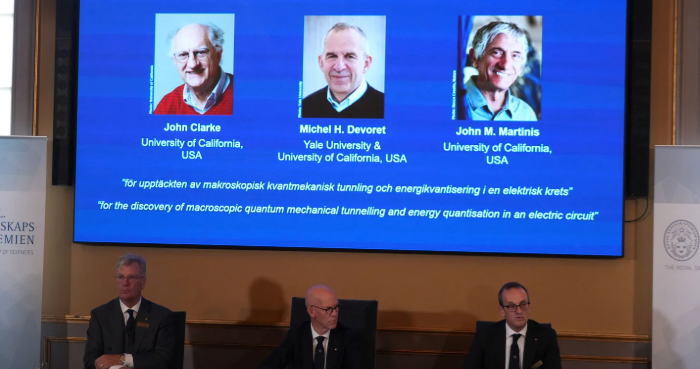
Three scientists on Tuesday were awarded the Nobel Prize in physics for demonstrating how quantum mechanics work on a new scale, with potential implications for the next generation of quantum technology.
The winners announced are John Clarke of the University of California at Berkeley, Michel H. Devoret of Yale University and the University of California at Santa Barbara, and John M. Martinis of the University of California at Santa Barbara.
The Nobel award was given “for the discovery of macroscopic quantum mechanical tunnelling and energy quantisation in an electric circuit” for experiments conducted in the 1980s that demonstrated the quantum tunneling phenomenon “in a system big enough to be held in the hand.”
Olle Eriksson, chairman of the Nobel Committee for Physics, said during a news conference in Stockholm that no advanced technology today exists that does not rely on quantum mechanics and quantum physics.
During the announcement ceremony, Clarke said on a video call that he still did not expect it would lead to a Nobel Prize. He called the award “the surprise of my life.”
This year’s Nobel laureates showed that quantum tunneling can happen on a macroscopic scale with many particles. In 1984 and 1985, they created an electrical circuit using two superconductors and a thin insulating layer, known as a Josephson junction, which does not conduct current.
In their experiments, the team applied a weak current through the junction and measured the voltage, which is related to the circuit’s electrical resistance. They expected the voltage to be zero, but instead, they observed it switching between zero voltage and a voltage state, indicating evidence of tunneling.
This tunneling demonstrated that the charged particles behaved collectively as if they were a single particle within the circuit.
Read More: US-Japanese trio win medicine Nobel for immune system research
The researchers confirmed quantum behavior in another experiment by examining how energy is quantized.
At the subatomic level, energy is absorbed or emitted in specific intervals, much like the rungs of a ladder. In their setup, the team introduced microwaves into the circuit while it was in its zero-voltage state.
They discovered that the system absorbed some of the microwaves and subsequently transitioned to a higher energy level, similar to the behavior of electrons in atoms.
Richard Fitzgerald, editor in chief of Physics Today, said, “It shows the relevance of quantum mechanics at the macroscopic scale, the scale that goes beyond this thing that we can’t see, we can’t touch, we can’t feel, into a scale that can actually harness and put to work.”
The work of the laureates builds directly on the 1973 Nobel Physics Prize. Brian Josephson shared the prize with Leo Esaki and Ivar Giaever for his predictions that supercurrents could tunnel through a barrier between two superconductors.