
Ceasefire with Taliban cautious hope, not peace yet, says Khawaja Asif
- By Web Desk -
- Oct 21, 2025


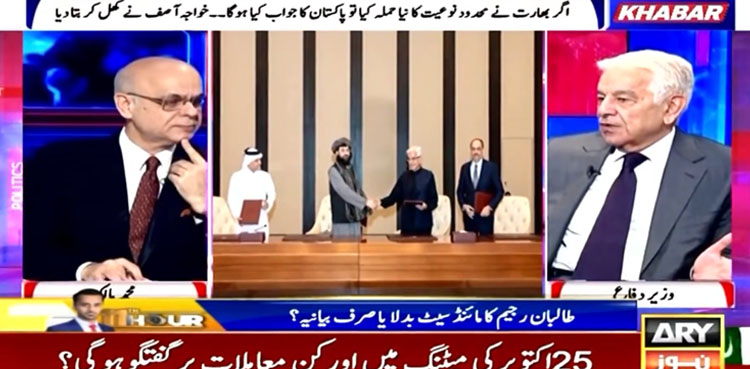
ISLAMABAD: Defence Minister Khawaja Asif has said that the ongoing conflict between Pakistan and Afghanistan is deeply rooted in the long-standing Durand Line dispute, stressing that the recent border tensions are part of a much older issue.
Speaking in ARY News program Khabar, Asif confirmed that a fragile truce exists between Pakistan and the Afghan Taliban regime, but warned that any new cross-border aggression could collapse the ceasefire agreement reached earlier in Doha.
The defence minister revealed that Qatar and Turkiye are mediating between Islamabad and Kabul in hopes of achieving lasting peace, adding that a follow-up round of talks will take place on October 25. “The next meeting will determine the real direction of the peace process,” Khawaja Asif said. “We have cautious optimism about the truce, but the situation remains delicate.”
Asif confirmed that the agreement with the Afghan Taliban regime includes multiple components, such as the return of Afghan refugees, the maintenance of a ceasefire, and an understanding that the outlawed Tehreek-e-Taliban Pakistan (TTP) will no longer be supported or allowed to operate from Afghan soil. “If another infiltration attempt occurs, the ceasefire will be at risk,” he cautioned.
He emphasized that Pakistan considers the Durand Line an international border, rejecting Kabul’s objections. “Afghanistan may call it a ‘so-called Durand Line’, but this boundary has existed for decades,” he said. “It is not a new issue—it has persisted since long before today’s conflict.”
The defence minister said that statements from the Taliban regime are not important, and that only the signed agreement matters. “They issue fiery statements to satisfy their own people, but the real understanding is written in the accord,” he remarked.
Asif noted that the Doha agreement will remain confidential, but confirmed that it includes mechanisms for monitoring compliance, as well as provisions for reporting any violations to the mediating countries. “If things don’t move according to the agreed mechanism, we will inform our brotherly nations, Qatar and Turkiye,” he said.
He reiterated Pakistan’s stance that Afghan refugees will be sent back with dignity, and that Islamabad’s policy on the issue remains unchanged. He also announced that Pakistan would review the Afghan Transit Trade agreement, citing security concerns.
Khawaja Asif further claimed that India is actively supporting the banned TTP, and that Islamabad has shared concrete evidence with mediators. “The Afghan Taliban regime knows that we have proof of their links with TTP leaders,” he added, saying such evidence will be presented at the upcoming Istanbul round of talks.
While acknowledging that relations between the two neighbors have historically fluctuated, Asif said Pakistan seeks a permanent and peaceful settlement. “Afghanistan was the last country to recognize Pakistan after 1947, and since then we have experienced both friendship and hostility,” he recalled. “It cannot yet be said that everything is normal—we have to remain cautious.”
The minister also hinted at internal divisions within the Taliban regime, stating that rifts between Kandahar and Kabul are now visible and may threaten the regime’s stability. “They fought their entire war in the name of religion, and that has fueled extremism,” he said.
Concluding on a measured note, Asif expressed hope for progress in the Istanbul peace process, saying, “If the next round succeeds, it will be good for both Pakistan and Afghanistan. We must remember—patience bears fruit.”