
Pakistan has successfully returned to international capital market: FM Aurangzeb
- By Web Desk -
- Apr 18, 2026


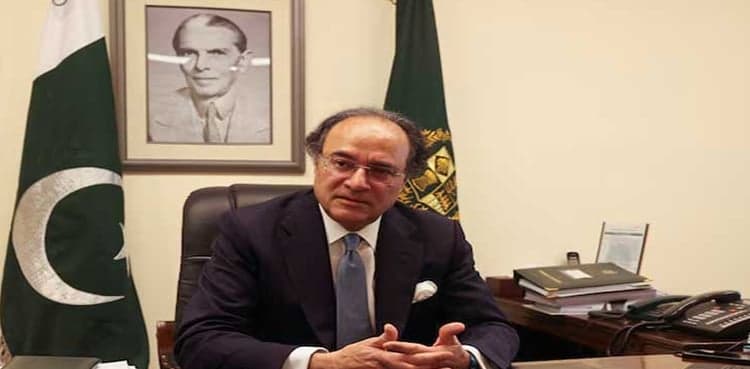
Federal Minister for Finance and Revenue of Pakistan, Senator Muhammad Aurangzeb, briefed Pakistani media representatives based in Washington, D.C. on Pakistan’s evolving economic outlook, progress on reforms, and outcomes of his engagements during the World Bank-IMF Spring Meetings 2026.
The interaction was also attended by the Governor of the State Bank of Pakistan, Jameel Ahmad, and Pakistan’s Ambassador to the United States, Rizwan Saeed Sheikh.
The finance minister Aurangzeb said Pakistan had successfully returned to international capital markets after a four-year absence, citing the private placement of a $500m three-year Eurobond. He described the move as a “vote of confidence” by global investors, reflecting improved economic management and policy consistency.
He stressed that restoring investor confidence requires adherence to sound economic fundamentals and maintaining what he termed “basic economic hygiene,” which remains central to the Government’s policy approach.
During the meetings, Aurangzeb said he held discussions with officials from key economies, including the United States, China and the United Kingdom, with a focus on expanding cooperation in trade, investment and sectors such as information technology, energy and minerals.
The minister also highlighted improved external sector indicators, noting that Pakistan recorded a current account surplus of more than $1bn in March.
Remittances reached $3.8bn during the same period, while inflows under the Roshan Digital Account rose to a record $261m,with expectations of further growth in April, reflecting sustained confidence among overseas Pakistanis.
He described overseas Pakistanis as a critical pillar of economic stability, pointing to growing use of formal financial channels as a sign of sustained confidence in the country’s economic direction.
On financial sector reforms, the Finance Minister outlined efforts to strengthen financial oversight and formalise exchange company operations, in coordination with the central bank and law enforcement agencies. Measures include improving transparency, increasing capital requirements and encouraging documented financial flows.
Addressing fiscal policy, Senator Aurangzeb outlined that preparations for the upcoming budget are underway through consultations with chambers of commerce, business councils, and other stakeholders. The government aims to broaden the tax base while incorporating stakeholder input before final approval by cabinet and parliament.
The finance minister acknowledged that bureaucratic delays and outdated procedures continue to affect the ease of doing business, but said reforms are being accelerated to simplify regulations and reduce administrative bottlenecks.
He also emphasised the importance of policy continuity, particularly in initiatives such as the Roshan Digital Account, arguing that predictable frameworks are essential to attracting long-term domestic and foreign investment.
On energy and climate policy, the Finance Minister underscored the importance of transitioning towards renewable energy, while also addressing structural challenges in the energy sector. He highlighted lessons learned from recent climate-related shocks, noting that improved fiscal buffers and institutional preparedness have enhanced Pakistan’s capacity to respond to natural disasters using domestic resources.
The Finance Minister also emphasized the importance of responsible borrowing practices, clarifying that international financial platforms should serve as mechanisms for knowledge sharing and peer learning rather than debt relief advocacy. He reiterated Pakistan’s commitment to honoring all its financial obligations in a timely manner.
Addressing global and regional developments, Senator Aurangzeb highlighted Pakistan’s constructive role in promoting peace and stability, noting that international recognition of Pakistan’s diplomatic efforts has strengthened investor confidence and enhanced the country’s global standing.
The Finance Minister further pointed to emerging positive developments, including increased transshipment activity through Pakistan’s ports and improved logistics management, which are contributing to economic activity despite challenging global conditions.
Concluding the interaction, Senator Aurangzeb reaffirmed the Government’s commitment to sustaining macroeconomic stability, advancing structural reforms, and maintaining a disciplined policy framework to support long-term, inclusive growth.