
CM Skilled Programs, Parwaaz Card, PICAL, AI Training program to get Rs.630.96 billion
- By Web Desk -
- Jun 17, 2026


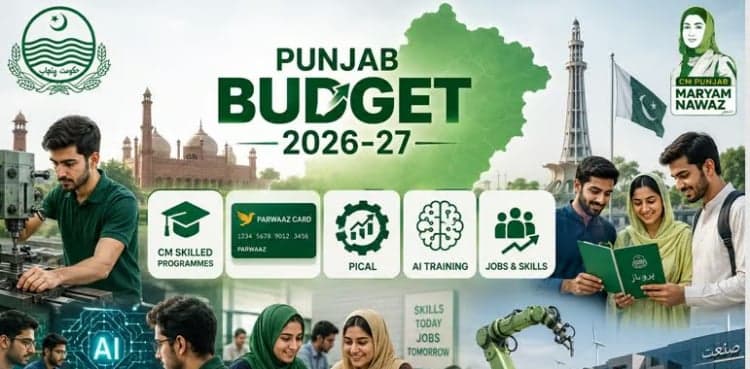
The government of Punjab revealed a skills development and entrepreneurship plan under its Annual Development Program (ADP) 2025-26, to train youths with market-relevant skills and generate new employment opportunities.
The initiatives include digital technologies, advanced manufacturing, hospitality, agriculture, entrepreneurship, and overseas employment, with a strategy to transform Punjab’s workforce and strengthen its economy.
A main component of the plan is the Chief Minister Skilled Punjab Program, for which Rs. 44 billion has been allocated and is expected to benefit around 122,000 youth through technical and vocational training designed to meet industry requirements.
In addition, the Chief Minister Skills Development Program will train 5,000 individuals over a period of 30 months.
The provincial government is also emphasizing strengthening technical and vocational education institutions through TEVTA and other training bodies.
Skills mapping exercises will be conducted to align the training program with local and global labor market requirements. New CM Skills Centers and hospitality laboratories are also planned to modernize training infrastructure.
Under the Advanced Technology Program-II, around 7,500 youth will receive training in cutting-edge fields, including Artificial Intelligence (AI), Data Analytics, Cloud Computing, Cyber Security.
Officials believe these investments will help prepare young people for the rapidly evolving global technology market and improve Punjab’s competitiveness in high-value digital sectors.
The Punjab government is also planning to expand its investment in Business Process Outsourcing (BPO). Through Program II, approximately 10,000 young people will be trained in customer service and business process management.
The Chief Minister Youth Employability in BPOs Program goals to train 25,000 young people over three years. For the initiative, an estimated Rs. 13.96 billion has been reserved.
The provincial government has also launched the Frontier Tech Skills and Innovate Punjab Program, with an estimated provision of Rs. 112 billion, which is expected to train 15,000 participants, develop the capacity of 1,200 trainers, and engage 60 institutions.
Tech Skills Boot Camps and makerspaces will be established across educational campuses to benefit approximately 70,500 youths.
Punjab is also investing in industrial modernization through the establishment of a Centre of Excellence for Advanced Automotive Technologies, with an estimated allocation of Rs. 99 billion.
The center is anticipated to train around 400 individuals in advanced automotive and manufacturing technologies.
The hospitality sector has also been identified as a priority area for workforce development. Under the proposed program, the Punjab government plans to establish around 60 hospitality laboratories and expand specialized training facilities.
Over 22,000 individuals are expected to benefit from hospitality-related training, helping meet the workforce needs of the tourism, hotel, and services sectors.
For backing overseas employment, Punjab has launched numerous initiatives aiming at preparing workers for international labor markets, including the Parwaaz Card Scheme for International Employment, and the broader Skills for Global Needs program.
In addition, the Language Skills Program aims to train 30,000 youth in foreign languages and communication skills mandatory for overseas employment opportunities.
Under the extensive workforce transformation outline, Punjab has launched the Skilling Punjab for Economic Transformation framework.
Under the Skills for Domestic Needs component, carrying an estimated allocation of Rs. 142 billion, training programmes will be aligned with the European Qualification Framework and supported through the establishment of Centers of Excellence.
In addition, the Skills for Global Needs component, with an estimated allocation of Rs. 51 billion, will focus on producing a workforce capable of competing in international markets.
The government of Punjab has also sought to expand economic opportunities for women through the Empowering Rural Women by Way of IT program. The initiative aims to train 15,000 rural women in digital skills, freelancing, and online income generation.
In agriculture and environmental sustainability, the provincial government intends to train about 20,000 youth for climate-smart agriculture, sustainable farming practices, environmental management, and green economy skills through the Skills for Agriculture and Green Environment (SAGE) program.
The program, with an estimated allocation of Rs .89 billion, seeks to prepare a new generation of workers capable of supporting climate resilience and sustainable development.
The government has also launched the Punjab Industry Cluster Academia Linkage (PICAL) initiative to strengthen collaboration between educational institutions and industry. With an estimated allocation of Rs .80 billion and a four-year implementation period.
The program is likely to benefit 25,000 youth by ensuring that academic training is better associated with labor market requirements and industrial demand.
Technical and vocational training will be further extended through the Punjab Vocational Training Council (PVTC), which is projected to train approximately 60,000 youth across multiple trades and vocational disciplines during 2025-26.
Work-based training opportunities, specialized technical courses, and industry partnerships will form an important part of this effort.