
Sindh budget 2026-27 presented with 816 development projects for Karachi
- By Sanjay Sadhwani -
- Jun 17, 2026


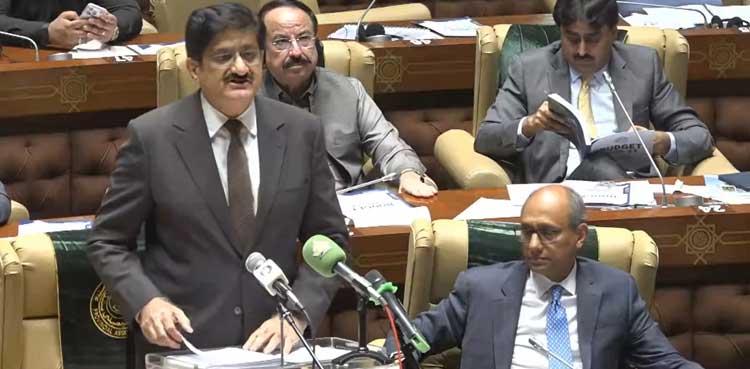
KARACHI: Sind Chief Minister Murad Ali Shah on Wednesday presented the provincial budget 2026-27 in provincial assembly. The CM announced that this budget has almost 816 development projects for provincial capital Karachi amounting to Rs644 billion.
The budget with a total outlay of Rs 3.652 trillion framed against estimated receipts of approximately Rs 3.41 trillion, resulting in a projected deficit of about Rs 242 billion.
Sindh government has committed to no new taxes while delivering a seven per cent increase in salaries and pensions, a Rs 400 billion development programme, and a Rs 13.2 billion social protection package for vulnerable communities.
CM Murad Ali Shah’s speech outlined a comprehensive strategy to transform Sindh into a regional hub for trade, finance, technology and renewable energy through a public-private partnership projects.
The chief minister noted that Sindh prepared its financial plan amid a challenging global environment marked by geopolitical tensions, inflationary pressures, climate-related risks and economic uncertainty as during the outgoing fiscal year, ordinary citizens continued to face hardships due to rising living costs, energy prices and inflation due to Iran war and other factors.
Salary and Pension Increases
The chief minister announced a seven per cent increase in salaries and pensions for public sector employees and pensioners, effective from July 1. This increase has been granted by amalgamating the Adhoc Relief Allowances of 2022 and 2025, providing consolidated relief to government workers.
The minimum wage has also been increased from Rs 40,000 to Rs 43,000 per month.
Murad Ali Shah emphasised that the Sindh government remains committed to shielding vulnerable groups from economic hardship.
The budget includes a Rs 13.2 billion social protection package comprising the Kitchen Garden Initiative, the Benazir Hari Card Programme, the Benazir Women Agriculture Workers Programme and support schemes for widows and orphans.
Karachi Development Projects
“Karachi being the engine of our economy, we have given top priority to its development in our FY 2026-27 budget. As the development portfolio of the city contains 816 schemes having the estimated cost of Rs 644.3 billion.”
The CM further noted that for the incoming year, Rs 100.19 billion has been allocated for Karachi’s project out of which allocations for the total 822 schemes are worth Rs 108.1 billion.
“We have 167 ongoing projects costing over Rs 500 million each and 110 mega projects of above Rs 1 billion each underway throughout the city,” she added.
Much of the allocations have gone into fixing Karachi’s transport woes and addressing its chaotic traffic scene.
Included in the Sindh budget are a Rs 1.2 billion airport road to Star Gate flyover, a Rs 1.5 billion right turn underpass from Malir halt to Shahrah-i-Faisal, as well as a Rs 1.65 billion flyover at the Shah Suleman Road crossing over Gujjarr Nulla.
Money has also been set aside for the Shahrah-i-Bhutto Korangi causeway junction, the Azeempura Intersection Flyover, new interchanges linked with the Malir Expressway, underpasses on Khayaban-e- Ittehad and Khayaban-e-Shahbaz.
To improve urban drainage and flood resilience, provincial government has allocated funds for the third phase of rehabilitation of major stormwater drains, restoration of Gujjar Nullah and its service roads, and the M-9 to Thaddo Nullah stormwater drainage project.
For Karachi’s water supply and sewerage infrastructure, allocations have been made for expansion of the K-IV water supply system, upgrading water pumping stations in Karachi East and Central districts, rehabilitation of the city’s trunk main network to reduce leakages, and construction of a new water supply line along the Lyari Expressway.
In the transport sector, the government has allocated Rs 13.2 billion for the Red Line Bus Rapid Transit project and over Rs 3.5 billion for the Yellow Line Bus Rapid Transit corridor.
Solid waste management remains another priority area for Karachi.
The CM announced formation of six modern garbage transfer stations, the Sindh Solid Waste Emergency and Efficiency Programme, and the upgrading of the Jam Chakro and Gond Pass landfill sites.
The health sector allocations for Karachi include Rs 1 billion for the Sindh Infectious Diseases Hospital and Rs 1.4 billion for the Paediatric Cardiology Unit at the National Institute of Cardiovascular Diseases Karachi. In education, funds have been earmarked for a new medical college, the Bilawal Bhutto Engineering College in Lyari, the Shaheed Zulfikar Ali Bhutto Law University, the Karachi Education Complex, and development projects at major public-sector universities including the University of Karachi and Jinnah Sindh Medical University.
The CM also announced the establishment of a Provincial Civil Services Academy at a cost of Rs 1 billion, a new Sindh Revenue Board training academy and office complex, and improvement of commercial centres and markets across the city.
Transformational Public-Private Partnership Initiatives
A highlight of the budget speech was the announcement of a new wave of mega PPP projects which would make Sindh a regional trade, finance, tech, green energy and sustainable development hub. The CM boasted that the province’s PPP model has become a global success story, earning praise even from the UN Economic Commission for Europe (ECE), The Asset magazine and The Economist, and turning it into ‘one of the best sub-national PPP models in Asia’.
Some key flagships include the proposed development of Keti Bandar as a “maritime, logistics, industrial and energy” hub. The government will undertake a globally benchmarked viability assessment of developing a modern coastal economic corridor encompassing port facilities, industrial zones, logistics/warehousing, export-oriented manufacturing, energy projects and multi-modal transport connections. The project will also look at connecting the Dhabeji SEZ, Thar’s energy potential and emerging trade corridors. The CM called Keti Bandar “the single biggest economic opportunity for Sindh in 50 years – the kind of transformative initiative that changed the course of Pakistan’s industrial history in the case of Port Qasim”.
Another big announcement was the plan to set up the “Sindh International Finance Centre (SIFC)” in Karachi. It is envisaged as a state-of-the-art platform for investment, infrastructure, Islamic, climate and other financing, fintech, commerce, etc. To attract foreign capital and improve investor confidence, the government aims to create “world-class laws, regulations and institutions” such as “modern commercial courts, arbitration centres and friendly regulations”. Three possible sites in the commercial belt of Karachi are being considered, and money has been allocated for an international-standard feasibility study.
Recognising the growing global demand for Ai and cloud computing, the government announced the Sindh Green Data Infrastructure Initiative which seeks to build renewable energy powered technology zones and large scale data centre parks backed by solar and wind energy resources available across the province to attract global tech firms, cloud service providers, AI companies and digital infrastructure investors looking for an eco friendly and cost effective place to operate. Officials hope the programme could spawn a new technology ecosystem and generate a surplus of clean power for industrial estates, desalination plants and special economic zones.
FREE SOLAR SYSTEMS
The chief minister also announced one of Pakistan’s biggest household renewables programs under which 275,000 free solar home systems worth Rs 18 billion will be given away to poor households and a subsidised solar financing programme will be launched via the Sindh Enterprise Development Fund (SEDF) and Sindh Bank allowing middle income families to put rooftop solar on their homes.
To modernise agriculture, the government plans to bring in legislation creating “farmer led agricultural collectives” that will help small farmers group together to share costs without giving up ownership of their lands. Collectives will be recognised as bankable entities and given access to cheap finance, insurance, machinery, storage, modern irrigation and market linkages to help improve productivity, water efficiency and climate resilience, and raise rural incomes.
The government also announced plans to launch an ‘Integrated Waste-to-Value & Circular Economy Programme’ as a PPP, focusing on turning municipal waste into economic resources through recycling, refuse-derived fuel production, methane capture and carbon credit generation. Officals hope that the programme will enhance urban environmental management and create new revenue and green jobs