
Sindh’s FRAMES school attendance system draws criticism over past reform failures
- By Hamid Ur Rehman -
- May 23, 2026


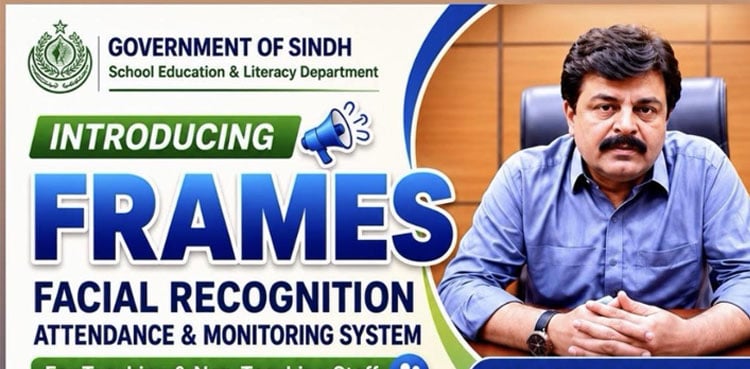
KARACHI: Former Pakistan Tehreek-e-Insaf (PTI) MPA Rabia Azfar Nizami has raised questions about the Sindh government’s facial recognition attendance system, “FRAMES,” for teaching and non-teaching staff in schools.
In a statement shared on social media, Rabia Azfar Nizami questioned whether Sindh’s facial recognition attendance system was about “accountability or optics.”
She also cited examples of similar past projects that failed and urged international donors to seek verified improvements before approving funding for such initiatives in Sindh.
Nizami asked: “At what point do international donors require proof of outcomes before writing the next cheque?”
The government’s FRAMES initiative uses biometric facial recognition and geo-fencing technology to track teacher attendance. “Technically sound. Politically brilliant. But Sindh has been here before — repeatedly,” she remarked.
A graveyard of similar projects
According to Nizami, this is not Sindh’s first attempt at tech-driven accountability in education.
The Reform Support Unit (RSU), funded by the World Bank and DFID, was intended to revolutionize school monitoring. However, she claimed it became a bureaucratic black hole due to teacher resistance, manipulation of attendance data by corrupt officials, and technical failures in rural areas.
Similarly, the Sindh School Daily Monitoring System (SSDMS), launched in 2022 with backing from the EU and UNICEF, aimed to establish real-time school monitoring. However, it struggled with unreliable internet connectivity, poor adoption, and never scaled beyond the pilot phase.
She further referred to SERP-I and SERP-II — a combined $400 million World Bank-funded programme — alleging that achievements at the end of the second phase were barely different from the first.
“Money squandered. Time lost,” she said.
Nizami noted that biometric attendance systems had already been tested in Sindh. Despite previous verification systems, teacher absenteeism remained a persistent challenge because, according to her, the core issue was never data collection but enforcement.
“Without penalties that actually stick, the system merely documents the dysfunction,” she argued. “The pattern is clear”.
Nizami said 17 years of “flashy announcements and small pilots” had produced little meaningful progress in Sindh’s education sector.
“Millions of children remain out of school, classrooms are deteriorating, and learning outcomes remain abysmal,” she stated.
She claimed that over 12,000 of Sindh’s 49,000 schools are non-functional, while schools have not received furniture in nine years.
“FRAMES may scan thousands of faces. The question history keeps asking — and Sindh keeps failing to answer — is whether any child will learn better because of it,” she added.
Questions over donor-backed reforms
Nizami pointed out that the broader digital attendance initiative (SAMRS/FRAMES) is backed by many of the same international donors whose previous education projects in Sindh failed to deliver substantial results.
The initiative falls under the SELECT Project — Sindh Early Learning Enhancement through Classroom Transformation — funded by the World Bank and the Global Partnership for Education (GPE), with a budget of $154.7 million covering 12 districts.
She noted that the launch ceremony was attended by representatives of the World Bank, UNICEF, GPE, ADB, the British Council, and JICA.
“It was essentially a who’s who of the same donor community that has financed Sindh education reforms for two decades,” she said.
Nizami also highlighted remarks by the World Bank’s Country Director, who stated at the launch that SAMRS was “not a donor-driven initiative but Sindh’s own plan.”
Calling it a “familiar framing in development circles,” she argued that attributing ownership to the government creates the appearance of local commitment while conveniently distributing accountability when expected results fail to materialise.
“The pattern is hard to ignore: the same donors, the same government, a new acronym,” she said.
“SERP-II failed to move the needle despite $400 million. The Reform Support Unit collapsed under bureaucratic resistance. The Sindh School Daily Monitoring System never scaled beyond a pilot. Now it’s SELECT + SAMRS + FRAMES.”
However, she acknowledged that the projects were “not total zeros.”
“Enrollment numbers shifted marginally. Some ghost teachers were identified. But literacy, learning levels, and dropout rates did not improve proportionally to the money spent. That gap between inputs and results is the real story,” she concluded.
She again questioned: “At what point do international donors require verified improvement before writing the next cheque?”